Memory
SuperLocalMemory
Governed, local-first memory for agents. Every recall points back to its source, and writers whose facts keep failing verification lose influence.
CodeAGPL-3.0
Topic hub · Memory
Agents forget between sessions, and when several agents share one store, a single bad writer can poison what all of them recall. Memory needs a source for every fact and a way to stop trusting writers whose facts fail.
Start here
Your progress is saved in this browser.
Reading path · 0 of 6 read
Tools
Memory
Governed, local-first memory for agents. Every recall points back to its source, and writers whose facts keep failing verification lose influence.
Coordination
Peer-to-peer messaging between agent sessions, with file locking and shared state so parallel agents don't overwrite each other.
Gateway
One hub process in front of every MCP server and every AI client, with federated tool discovery, a shared cache and cost telemetry.
Research
Governed memory with scoped component evidence and disclosed negative results
Seven retrieval channels and zero LLM calls in the hot path; 70.4% on LoCoMo in zero-LLM mode
75% LoCoMo accuracy without cloud calls, from a four-channel retrieval architecture
Shared memory is an attack surface — Bayesian trust scoring that degrades a poisoned writer instead of trusting it
Glossary
When one compromised or careless agent writes false facts into a memory store that other agents share, so every agent that recalls from it is misled.
A per-source trust score, modelled as a Bayesian posterior and updated by downstream outcomes, so a writer whose facts keep failing verification loses influence over retrieval.
Memory retrieval that ranks results by computation, such as distances on a statistical manifold, instead of calling a language model in the hot path.
Searching memory through several independent channels at once and fusing their results by reranking, so no single index decides what is recalled.
Deliberate forgetting with decay curves and consolidation, so old facts stop crowding out current ones as a memory store grows.
A record of where a remembered fact came from, kept alongside it so any recall can be traced back to its source.
Writing
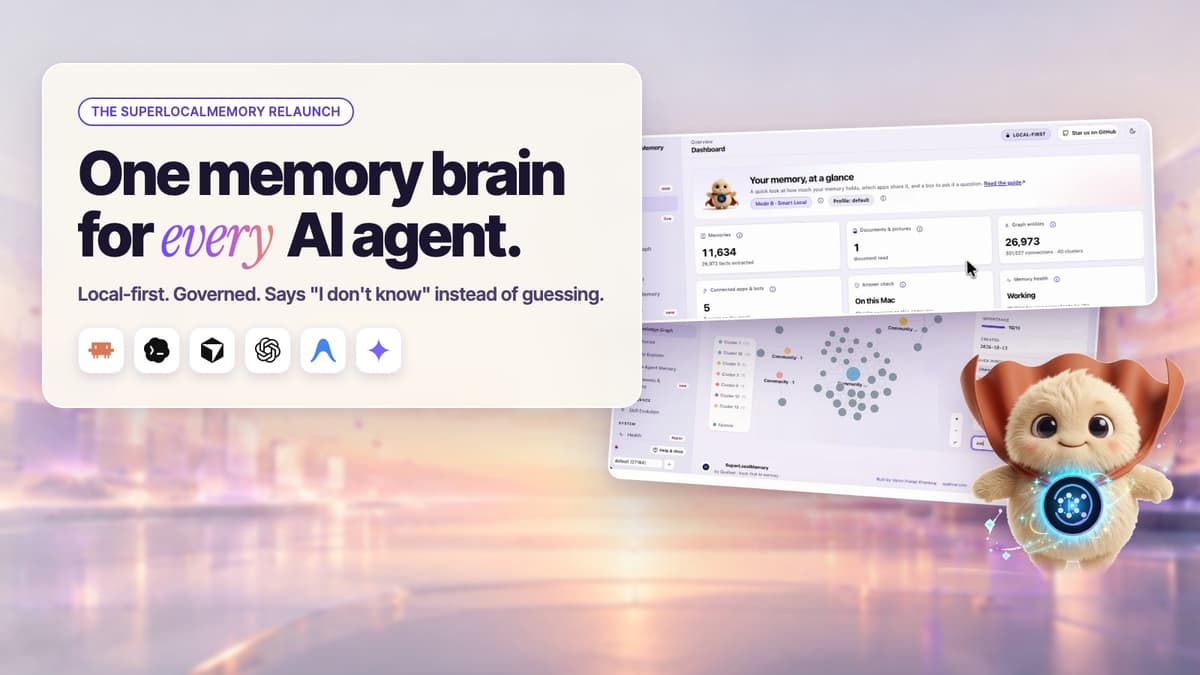
What's changing
SuperLocalMemory is relaunched: one governed, local-first memory brain for Claude Code, Codex, Cursor, ChatGPT and every agent that speaks MCP or runs a command.
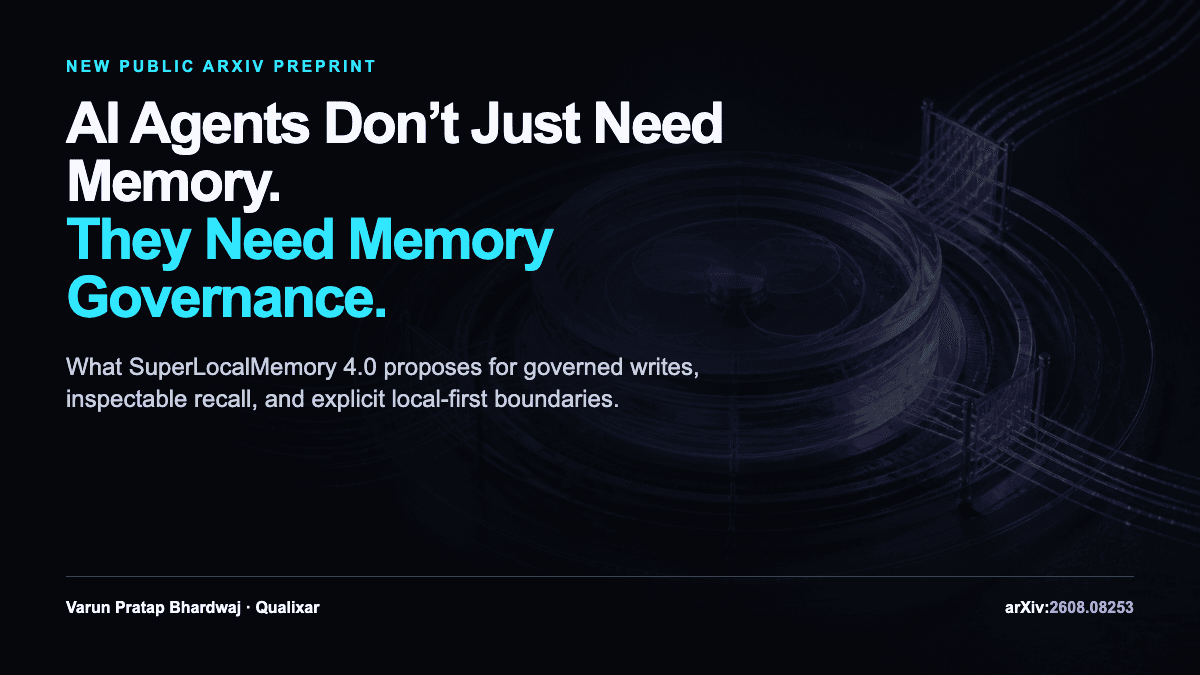
Research explained
The SuperLocalMemory 4.0 paper argues that durable agent memory is operational state—and proposes governed writes, inspectable recall, explicit local-first boundaries, and verifiable operations.

How we built it
A ground-up explanation of AI memory: vectors, time, graphs, ingestion, multi-channel retrieval, controlled forgetting, isolation, and safe learning.

How we built it
A local-first way to skip repeat LLM calls, compress prompts 60–95%, and trigger your provider's own KV-cache discount — one line, open source.

What's changing
When the next phase of the EU AI Act applies, if your agent's memory runs through a cloud service you own a new question. A local-first, architecture-first take.

What's changing
Multi-machine mesh support ships in both products. M4 and M5 coordinate as one. Real-time push, mDNS auto-discovery, zero config.

Field reports
Severance gave us a vocabulary for what AI coding agents actually do. They start every session as innies — no memory of yesterday's work. That is not a UX bug. It is the bottleneck.
What's changing
Google's Project Jitro (Jules V2) is building a persistent agentic workspace with goals, insights, and history. This is exactly the problem SuperLocalMemory solved — locally, privately, and months earlier.
Field reports
Open your terminal. Start a session with any major AI coding tool — Cursor, GitHub Copilot, Windsurf,...
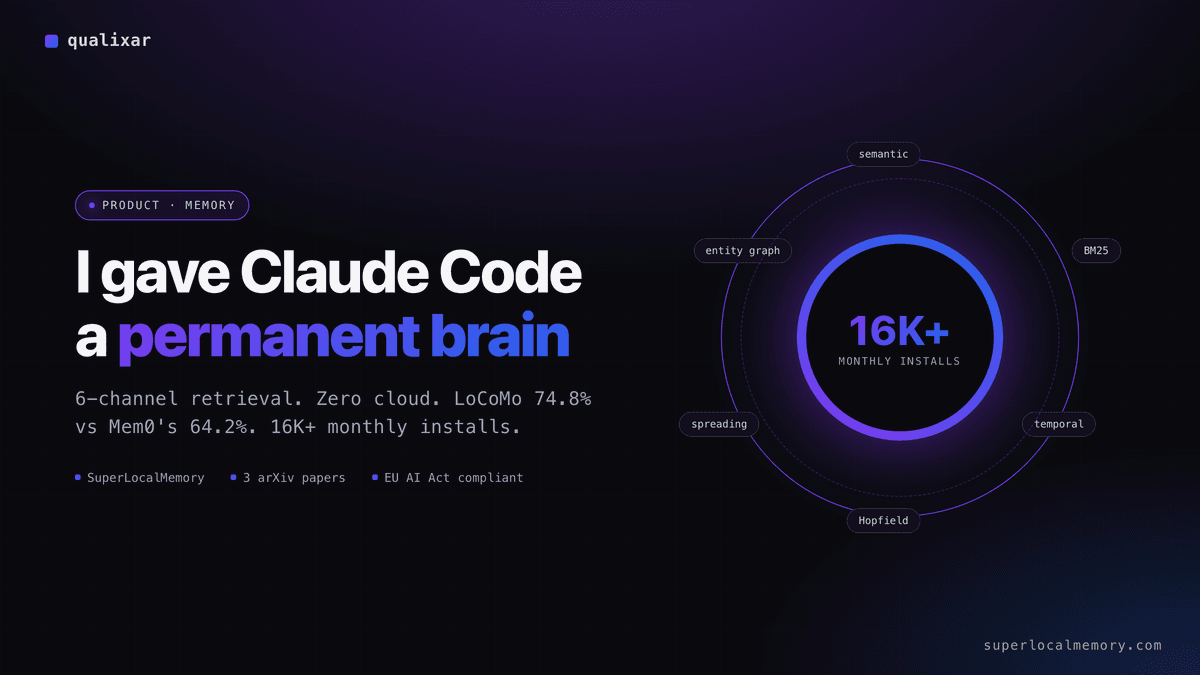
How we built it
Your AI agent forgets everything between sessions. Here's how to fix that with one command — no cloud, no API keys, no cost.