Testing
AgentAssay
Stochastic testing for agents: verdicts over repeated runs that account for randomness, at a fraction of the tokens a naive repeat-and-compare spends.
CodeAGPL-3.0
Topic hub · Evaluation
An agent's output legitimately changes from run to run, so a golden-file diff fails on correct runs and passes broken ones. Testing has to judge the distribution of runs, at a token cost a team can pay.
Start here
Your progress is saved in this browser.
Reading path · 0 of 5 read
Tools
Testing
Stochastic testing for agents: verdicts over repeated runs that account for randomness, at a fraction of the tokens a naive repeat-and-compare spends.
Research
Sequential testing needs 78% fewer trials; trace-first analysis of existing traces adds no token cost
Glossary
A test result reached over repeated runs of a non-deterministic agent, judging the distribution of outcomes instead of a single sample.
Checking that a change did not make an agent worse when its output differs every run, so comparing against a golden file is not possible.
Writing
Field reports
Google's Gemini 3.8 Flash and Meta's Muse Spark 1.3 promise frontier intelligence at budget rates. But across Hermes, OmniRoute, and OpenRouter, token price is only 20% of your bill. Here is why model portfolio routing beats leaderboard hype.

Field reports
LLMs are not dead. But the next AI race is about predicting what changes after an action. Cosmos 3, Qwen-Robot, the taxi-map trap, and the reliability test that matters.

Research explained
An ACL 2026 paper just proved RL-trained reasoning causally amplifies tool hallucination. Here's the mechanism, the math, and what AI Reliability Engineering does about it.
Field reports
Anthropic missed three regressions. Uber burned its 2026 AI budget. 300k Ollama servers leaked memory. Princeton paused its leaderboard. Five headlines, one engineering failure: reliability under accumulated state. The metric that exposes it, three Monday-morning fixes, and the runtime contract framework that gates it.
Field reports
I ran GPT-5.5, Claude Opus 4.6, and Gemini 3.1 Pro through real benchmarks. Iron Man, Captain America, and Thor all showed up. Nobody won. Here's why that's actually the point.
How we built it
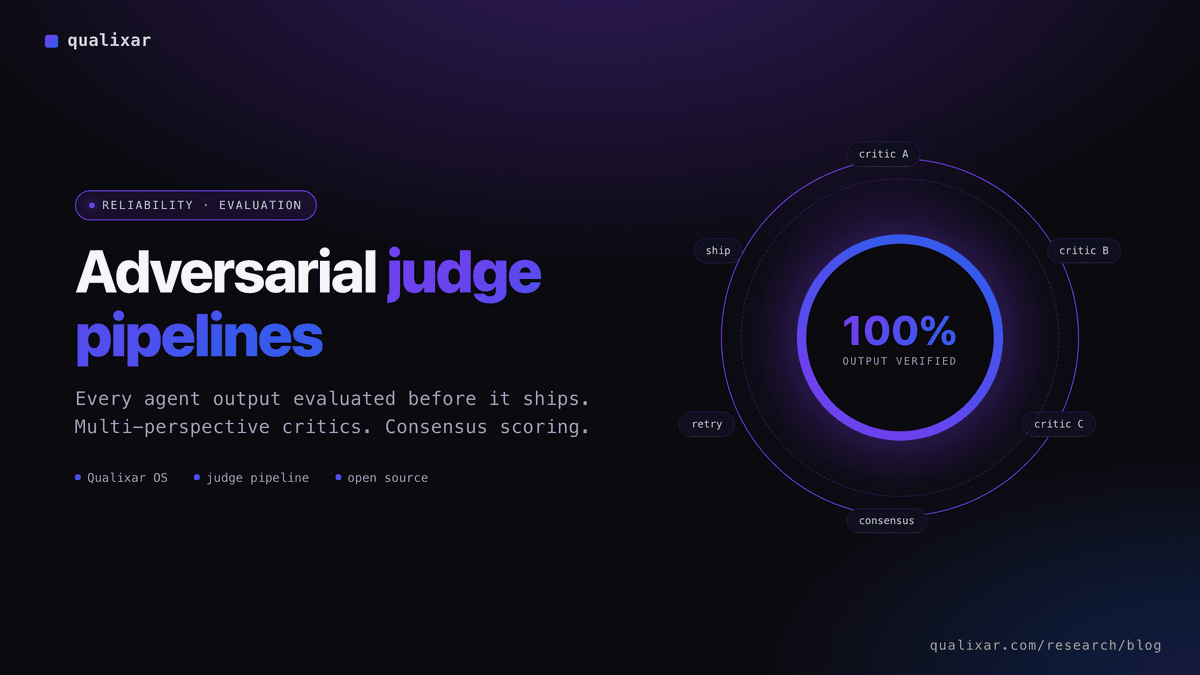
Most AI agent frameworks skip output quality entirely. We built a 2-round adversarial judge pipeline with multi-model consensus, anti-fabrication verification, and configurable profiles — and tested the same principle by having 7 independent AI auditors evaluate our own codebase.