Contracts
AgentAssert
Design-by-contract for agents: preconditions, invariants, governance and recovery checked at runtime, so a violation is caught at the step that caused it.
Decisions · Jev Decision Layer
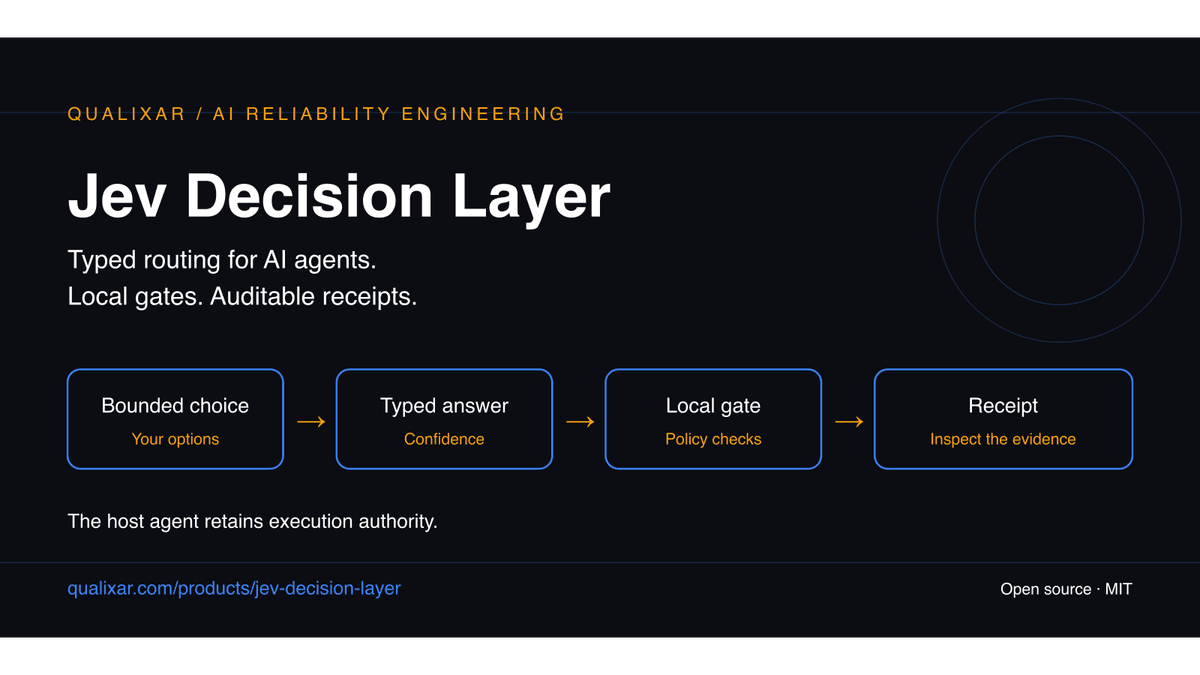
Give your assistant a bounded task, tool, skill, or review choice. Receive a typed answer with confidence and a local receipt. The host keeps execution authority and verifies the work.
Offline first
On macOS with Python 3.11 or newer and Git, replay the shipped synthetic answers through the real checking logic. No key or provider call is needed.
git clone https://github.com/qualixar/jev-decision-layer.gitcd jev-decision-layerplugins/qualixar-jev-decision-layer/scripts/jev selftest
The self-test checks gate contracts. It does not measure provider accuracy or savings. With Node.js 20 or newer, node tools/demo.mjs replays twenty recipe examples across nominal, uncertain and adversarial cases.
Install
codex plugin marketplace add qualixar/jev-decision-layercodex plugin add qualixar-jev-decision-layer@qualixar-jev-layer
Restart Codex, then ask to set up Jev for a folder. Enter any provider key only in the private setup page and review the scope yourself. Other hosts and upgrades.
Release 1.0.15; product page reviewed 2026-10-31. Source and host verification. macOS (supported); Linux (experimental); Windows (disabled). Jev is an AI Reliability Engineering decision primitive. Hosted decisions use the provider and scope you approve.
Evidence and adoption boundaries
Built by Varun Pratap Bhardwaj under Qualixar. This is an independent integration, not an official TypeSafe or host-provider product.
Recipes
55 typed decision recipes for agent routing, research, content and delivery. Choose a specification, supply its inputs and review the advisory result.
What it does
Choose from known options, score against a rubric, or check a statement with a yes/no likelihood.
Check reviewed workspace scope, recognizable secrets and request limits before a hosted call. Screening is best-effort.
Review the recommendation and local policy result. An advisory answer never grants tool permission.
TypeSafe Jev is the primary hosted route. Optional local Laya requires a separately verified Apple-Silicon installation.
Use bounded contracts for routing, extraction checks, retrieval relevance and review attention. Confidence thresholds remain uncalibrated defaults.
Codex, Claude Code, VS Code, Hermes and Antigravity have different verification evidence. Read the host guide for the exact boundary.
Use it for
Changelog
The latest releases on GitHub.
Decisions sent through OpenRouter are no longer refused. OpenRouter names the dated version of the model that answered, and Jev treated that as a different model. A dated version of the requested model is now accepted, nothing else is, and the local receipt records which…
On Linux, the setup and workbench commands exit as soon as they finish.
Local Laya setup, seventeen new recipes, and hardening throughout.
Qualixar Jev Decision Layer 1.0.12 — Name the Policy That Blocks It
When an organization manages Claude Code, its policy can stop the Jev plugin's hooks, keep the plugin from loading, or leave its MCP server off an allowlist. Until now the plugin just went quiet and nothing said why. A tool that stops working without a word is a reliability…
Qualixar Jev Decision Layer 1.0.11 — Approve Once, Every Harness
Qualixar Jev Decision Layer lets a coding agent hand small, consequential choices (which tool, which task, which files matter, whether an extraction matches its source) to TypeSafe Jev, then continue through the host's own permissions. It is part of Qualixar's AI Reliability…
Qualixar Jev Decision Layer 1.0.8 — Fast, Typed AI Agent Decisions
When an agent reaches a small but consequential choice—tool, task, test, or review path—it can ask TypeSafe Jev, a model built for fast typed decisions, and continue through the host's normal controls. Qualixar Jev Decision Layer makes that flow reusable across harnesses.…