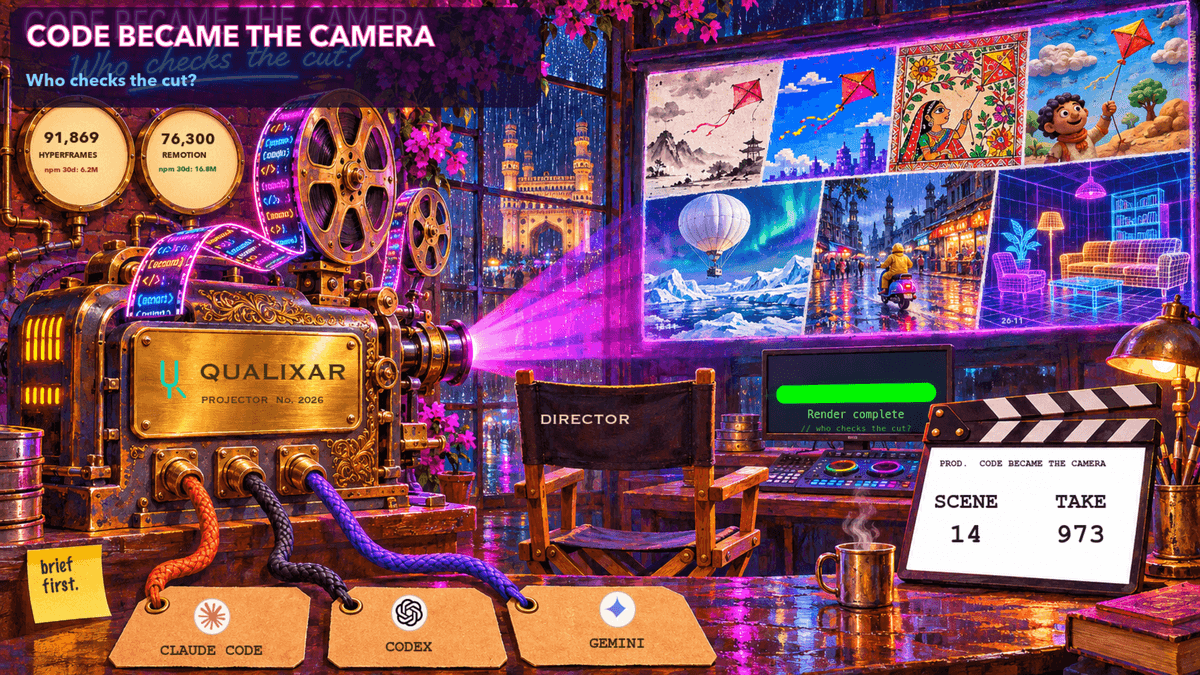
Varun Pratap Bhardwaj · AI Reliability Engineering · 29 November 2026
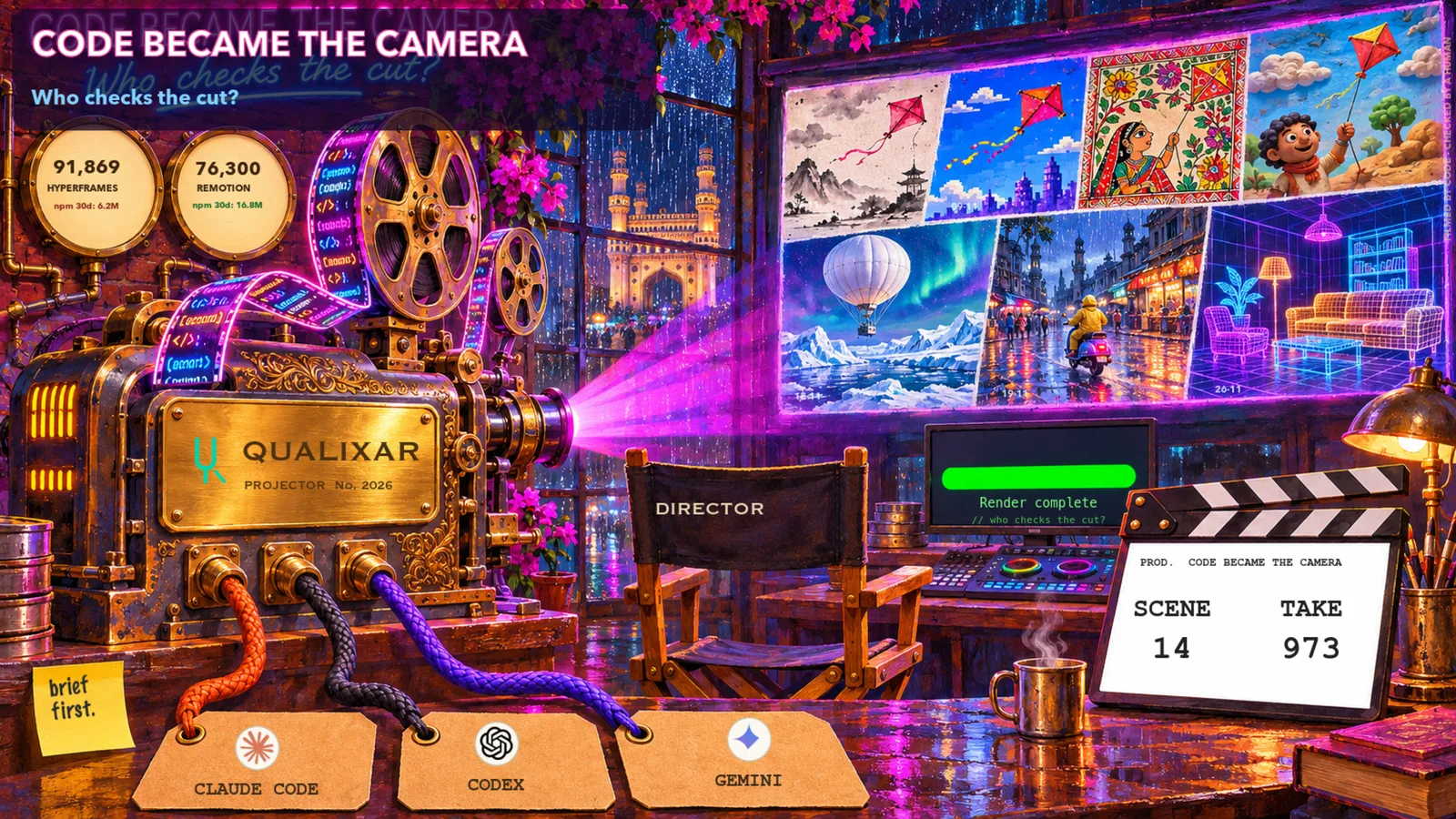
On 25 November, Anthropic's own account posted a thread of things people had made with Claude Fable 5.2. The first clip traced where the letter A came from, one alphabet at a time. Others drew the Seven Wonders of the Ancient World in motion, folded origami step by step "in code", and showed a robot arm playing 62 moves of checkers while correcting for its own 7 mm sag. Three days later the lead post had passed 1.2 million views.
The next day Andrej Karpathy wrote that Opus 5.5 had pulled 31 real data sources into a playable Civilization-style map of the United States, "7 hours and 45K lines of code later." Then, almost as an afterthought: "Claude also made a trailer." That post passed three million views.
Nine days before, OpenAI had published a 1:22 video of GPT-6.2 Astra rebuilding a room in Blender from two video frames. On 23 November its developer account posted what looked like a film reel from San Francisco's 1915 World's Fair and added, "we made the whole thing in Blender."
Nobody I know expected Claude Code to become a motion designer. Video models kept improving this year, so the surprise is not that machines make video. It is that a coding model is making it, by writing a program. The signs came earlier. Anthropic's Opus 5.5 launch post on 22 September quoted a game-building trial where it "scored higher than any other model on the strength of its graphics and polish," and within days people were posting launch films and explainers made with it. On 8 October came Claude Motion.
The short version: a film made by code is a project you can open, so an agent can render, look, fix and render again. Nearly every major editor has added a door for agents, and the people who make video are changing. What nobody has shipped is the check. Figures are as of 28 November and typed as primary, press or self-reported; my own readings are labelled as mine. Disclosure: we build in this space, and the last section covers our own work.
Part 1 · The pledge: video became a program
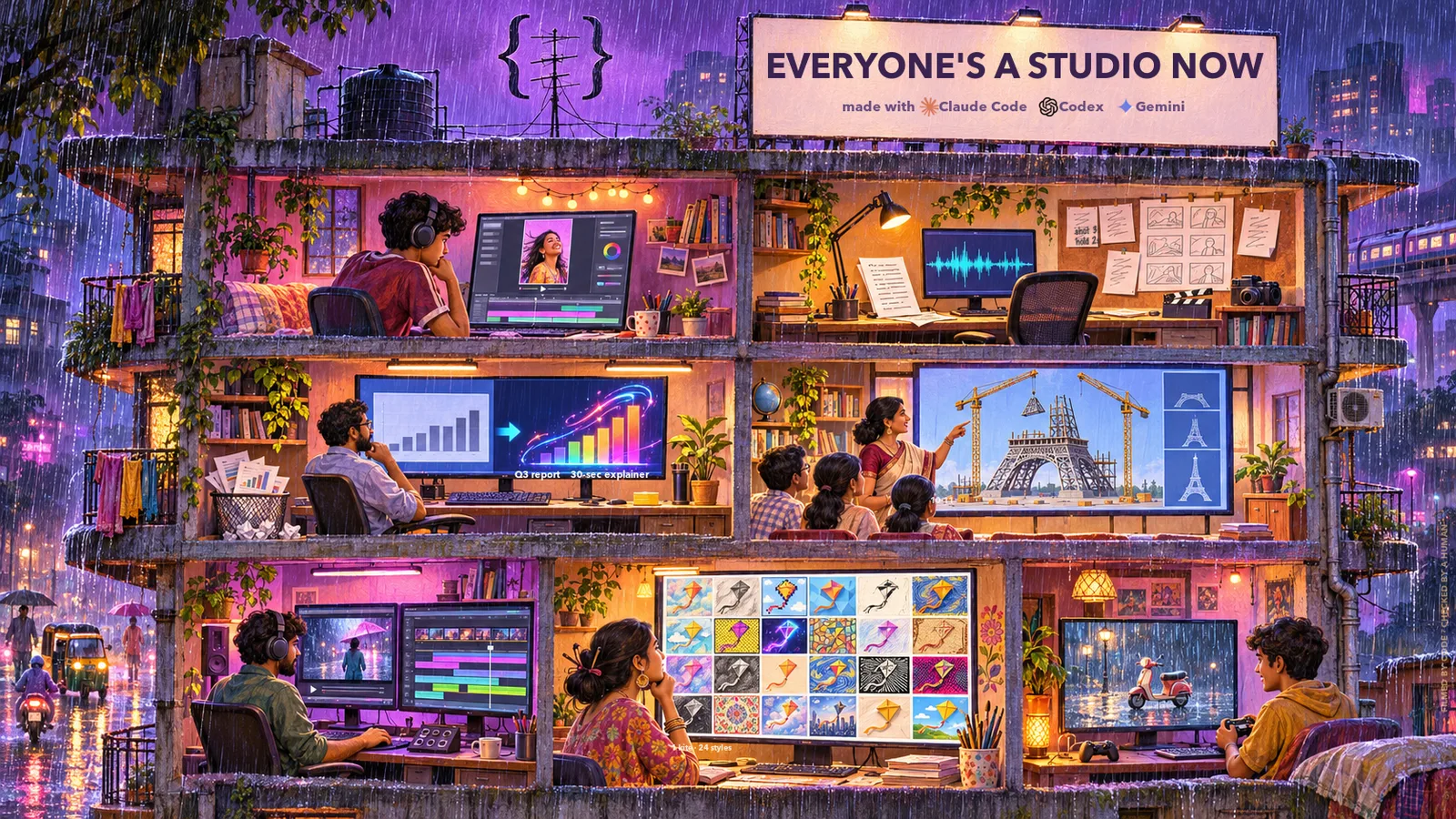
What each lab put on screen
Anthropic leads. Claude Motion went into beta for Team and Enterprise plans on 8 October. Claude "writes code that animates your text, charts, shapes, and images," and Motion "doesn't use a video generation model, so there's no generated footage and no AI-generated people." Change one number and the rest of the animation holds. Export an MP4, or take the project to Adobe, Descript, HeyGen, Runway (a launch partner) and others. Anthropic pitches it for explaining your own work, such as a quarterly report turned into an all-hands explainer, and its help article says it does not create realistic footage or people. Its connector directory also lists HyperFrames by HeyGen as "Anthropic verified."
The Fable 5.2 launch page, on 9 November, lists gains in "coding, reasoning, and vision" and says nothing about animation. Its nearest line is a Unity customer praising "building higher-quality 3D scenes from scratch." The motion story came from users first. The 25 November thread credited seven creators; one, DreW's Seven Wonders, was posted on 10 November, the day after launch. The captions name no tools and the original posts sit behind X's login wall, so we cannot say which used a code library, Blender or something else. Only the origami caption says "in code".
OpenAI went after realism. Its 17 November GPT-6.2 launch came with the two-frame room: Astra, in Codex, builds the set in Blender, changes decor and lighting, and turns the scene into an interactive space and a webcam background. On the launch page Astra also wrote a Python solver for a car's tyre and suspension dynamics and "animated the results in Blender." OpenAI's explanation is a vendor claim: gains in "visual reasoning and computer use carry over to 3D design." A builder in its own thread, after months on a 3D game with both models, replied that "Astra lags far behind Fable in design."
Google went after scale. Gemini 4 Carbon, on 10 November, previewed /swarm in Antigravity, which turns one prompt into a coordinated team of agents. One demo was an interactive Three.js exhibition of the Eiffel Tower's construction from historical photos and plates. Google says Carbon "checks both its code and the rendered UI," a sentence that matters below. Gemini 4 Neon followed on 18 November with a first-person ski simulator written from scratch: 10,200 lines of custom shaders, real Mont Blanc terrain, 120 Hz physics and avalanches. Google's Atlantis demo starts from a Gemini Omni video reference before modelling the ruins in Blender, so even that demo is a hybrid.
How code becomes video
A film made this way is a program. HyperFrames, HeyGen's renderer built for agents, turns HTML, CSS and GSAP animation into MP4. Remotion does it from React. Others are three.js, Python driving Blender, and Manim for maths.
The property that makes it work is in HyperFrames' documentation. The renderer does not play the video. It derives each frame from the frame number, "time = floor(frame) / fps," and "real time is never consulted." GSAP timelines are "paused and seeked, never played." Headless Chrome captures that exact frame, FFmpeg encodes the result, and the docs sum it up: "Same input, identical output. Every time." The docs' own caveat: renders on different machines can differ by a pixel, which Docker pins.
An illustration of the principle, not HyperFrames' or Remotion's code:
def frame(n, fps=30):
    t = n / fps                    # the only clock there is
    return draw(project_files, t)  # same files, same t, same pixels

frame(412)  # render this one frame, look at it, change a value, render again
My reading, and it is a reading: if frame 412 is a function of the project files, an agent can render frame 412 alone, look at it, change one value and render it again. A diffusion model has no source file for frame 412. You can regenerate the clip, and some tools now edit inside one, but you cannot open the frame and fix the line that drew it. No vendor has measured this and we have not run a controlled comparison. The vendors' pages fit it: Motion's "you can change a single detail," Carbon's check of its own render, the vision gains all three labs report, and Anthropic's account of more than 1,000 subagents working for eight days. I am assembling that from separate pages; no lab makes the argument. Determinism gives you a repeatable render, not a correct one.
The objection: the video models are still there
Code is not the only route. Images 2.6 (4 November) makes GIFs straight from the image model. Arena's text-to-video board on 8 November had Gemini Omni 1.2 Flash on top at 1,540, with Grok Imagine Video 1.5 and Seedance 2.0 in the top five. And no blinded arena covers video made by code: Artificial Analysis's video arena has text-to-video, image-to-video and video-editing modes only. The claim is narrow. For motion graphics and explainers, code gives an agent something to open and edit. It does not say the video models lost.
How it is judged now
For two years models were compared on score tables. This autumn the comparison moved toward the work. On Artificial Analysis's AA-3D arena, human judges see two blinded 3D scenes built from the same brief. On 28 November the board read GPT-6.2 Astra 1,318, Claude Fable 5.2 1,271, GPT-6.2 Sol 1,259 and Gemini 4 Neon 1,246, with ranks two to four statistically tied. At launch on 12 October the top score was 1,194, Claude Sonnet 5.5's. Read the 124-point rise carefully: it compares the best entry then with the best now, ratings move as votes arrive (Sonnet 5.5 shows 1,204 today), the field grew from 21 models to 30, and the panel size is unpublished. OpenAI cites the result on its own launch page.
Arenas are not the last word, and the builder above is the counterexample, so judge on your own brief. That is why we ran a contest on 15 November: the same motion-graphics briefs to Fable 5.2, Opus 5.5 and GPT-6.1, four rounds, eleven entries, every film published with checksums. Games, GTA 6 on 19 November among them, are a second thread this post mostly leaves aside.
The wave, May to November
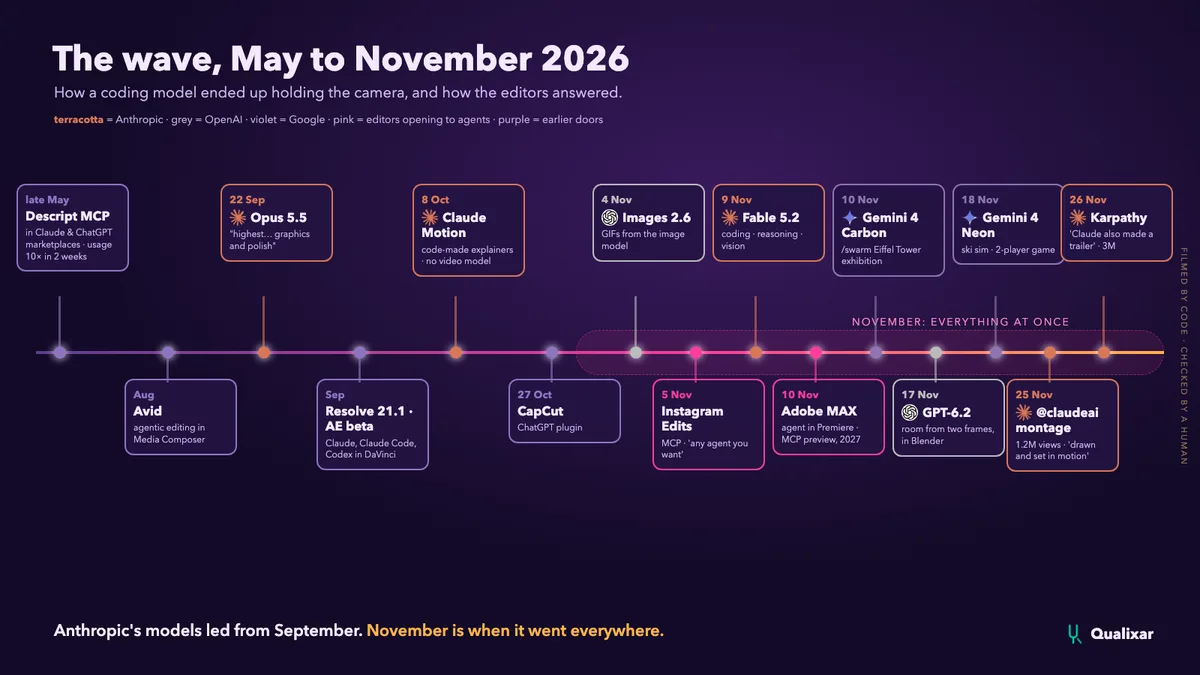
| 2026 | What happened | Basis |
|---|---|---|
| Late May | Descript's MCPs launch in the Claude and ChatGPT marketplaces; Avid shows agentic editing on 27 Aug | Company pages |
| 8 Sep | DaVinci Resolve 21.1 adds Claude, Claude Code and Codex integration; Adobe opens an After Effects AI Assistant beta | Blackmagic; Adobe |
| 22 Sep | Claude Opus 5.5; creators post films made with it through 27 Sep | Anthropic; creators self-reported |
| 8 Oct | Claude Motion beta | Anthropic; Runway |
| 27 Oct | CapCut announces a ChatGPT plugin | CapCut newsroom |
| 5 Nov | Instagram Edits Desktop for Mac, with an MCP for all its tools | The Verge |
| 9 Nov | Claude Fable 5.2 | Anthropic |
| 10 Nov | Adobe MAX: Creative Agent in Premiere and After Effects; Gemini 4 Carbon | Adobe; Google |
| 17 Nov | GPT-6.2 Astra and Sol, with the two-frame room video | OpenAI (page undated; date from press and the YouTube upload) |
| 18 Nov | Gemini 4 Neon | |
| 23–26 Nov | OpenAI's Blender reel (23), a filmmaker's phone-built Resolve trailer (24, self-reported), Anthropic's thread (25), Karpathy's trailer (26) | X posts |
Every editor announcement came before the late-November montages. Nor does the sequence show the labs planning this: Anthropic shipped Claude Motion seven weeks before its own account showed the montage, and the Fable 5.2 launch page never mentioned animation. What the table shows is a stack assembling over six months, with the November demos as the part people could see.
The editors opened their doors
Instagram Edits Desktop is free and Mac only. Matthew Simari, head of product management for Edits, told The Verge it has "a MCP for all the tools within Edits Desktop. You can use any agent you want." An agent can make a rough cut, after which you "open that project file in Edits to continue editing" and "go back and forth from agentic to manual editing."
Adobe, at MAX on 10 November, put its Creative Agent in Premiere and After Effects, "putting them in the director's chair so they can stay focused on their craft." In Premiere it applies effects "across every clip in a sequence," tracks masked subjects and adjusts colour across a whole sequence. A local MCP preview would let "preferred third-party agents" edit "native project files on the user's computer," with layers, bins and sequences still editable; Adobe's release says private beta, early 2027. In After Effects 27.0 the assistant reorganises projects, writes expressions and generates images and video; enterprise access is off by default, and Adobe says credit rates are "introductory and may change."
DaVinci Resolve 21.1, released 8 September, "now supports integration with AI assistants such as Claude, Claude Code and ChatGPT Codex" to analyse projects, organise media and batch render. It is a free download. The release does not say MCP, so I will not either. CapCut announced "bringing CapCut to ChatGPT plugins" on 27 October.
Apple is the exception. Its new MCP support reaches Keynote, Pages and Numbers, and we found no announcement of one for Final Cut Pro.
The Adobe paradox
It would be easy to write that Adobe opened up because nobody uses Premiere. The evidence does not support that. Adobe reported third-quarter revenue of $6.76 billion, up 13 percent, with AI-first recurring revenue up more than 150 percent, and it publishes no Premiere seat numbers. What moved is the market's mood. Market commentary has the stock down a quarter or more this year (sources range from 25 to 31 percent), Citi cutting it to Sell on 4 November, its third downgrade in about three weeks, and Anil Chakravarthy becoming chief executive on 1 December. One inference, which Adobe has not said: investors are pricing in a future where an agent opens the timeline, and Adobe's answer is to let it in and keep the professional in the chair.
The open stack grew up in eight months
The other half of the story is on GitHub (API figures, 28 November).
| Tool | Stars | Created | What it is | Licence |
|---|---|---|---|---|
| HyperFrames (HeyGen) | 91,869 | Mar 2026 | HTML/GSAP to MP4 for agents; a skill rebuilds any video as an editable project | Apache-2.0 |
| OpenMontage | 83,997 | Mar 2026 | "agentic video production system" | AGPL-3.0 |
| Remotion | 76,300 | Jun 2020 | React to MP4 | Custom company licence |
| Manim | 97,053 (original), 43,030 (Community) | 2015 (original) | Maths animation | MIT (Community) |
| Blender MCP | 36,116 | Mar 2025 | An agent driving live Blender | MIT |
| rea-video | 14,158 | 29 Oct 2026 | "Reverse-engineer any video, shot by shot" | Apache-2.0 |
| ffmpeg-skill | 12,171 | Sep 2026 | 42 FFmpeg tools with an MCP server | MIT |
| OpenFilm | 9,686 | Oct 2026 | Agent plus editors "to change anything it makes" | MIT |
HyperFrames and OpenMontage did not exist in February, yet each has more stars than Remotion, which dates from 2020. I am not ranking every video tool by stars; Manim's original is the older lineage.
Stars measure attention, and installs tell a different story. From 29 October to 27 November, Remotion had 16,765,271 npm downloads and HyperFrames 6,153,553; in the last full week, 3,708,017 and 1,437,808. The ratio is about 2.6 to 2.7 to 1 in both windows. These counts include continuous-integration and mirror installs, so they are not unique users. The two rankings disagree: HyperFrames leads on stars, Remotion on installs.
A second wave is tools you can own. The REA repository, an agent-driven reverse-engineering project created 14 April, has 481,780 stars. Storytold then released a free, open suite: PhotoCraft (81,949 stars), Craft Anything (45,039 within four weeks), and FilmCraft, a Premiere-class editor (19,155). Only timing links REA to Storytold. The apps are alpha, and stars are attention, not users.
Who makes the video now
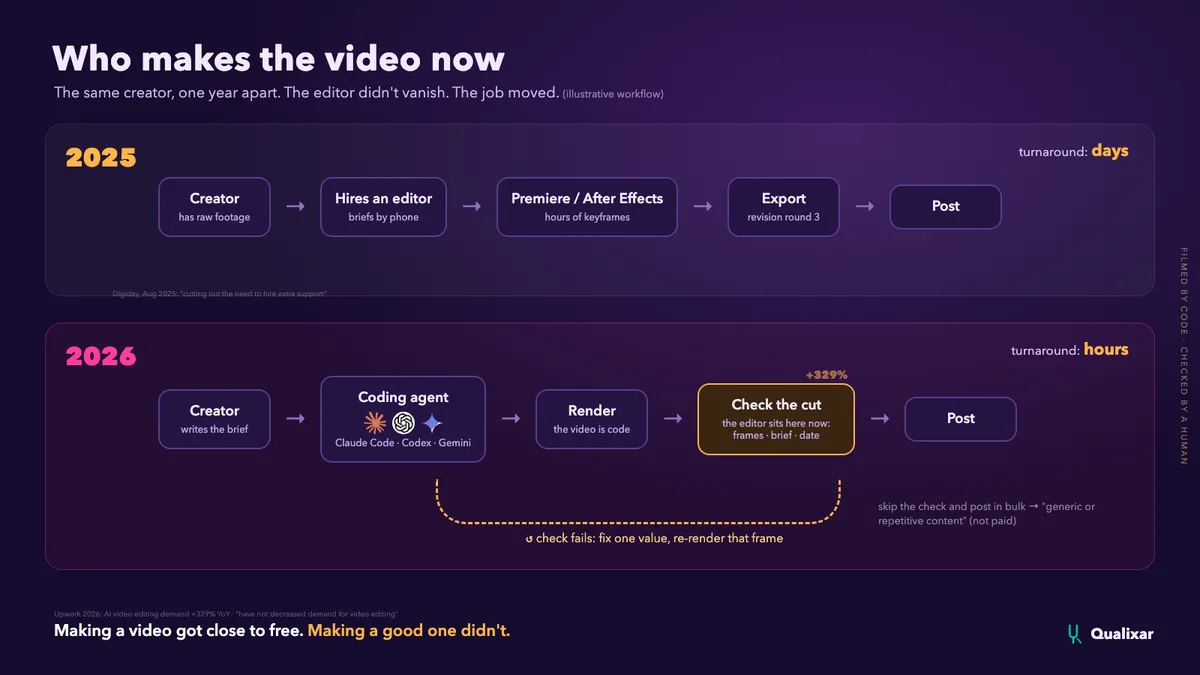
This is the part I see with my own eyes, so I will speak for myself and keep it apart from the numbers.
The editors I know who used to cut for influencers and YouTubers are shifting to AI. Many influencers no longer go to an editor at all. They hand the footage and a few lines of instruction to Claude Code and do it themselves. Nobody needs to learn Premiere Pro to make a small reel. Editors are still useful when they work with these tools, but the small jobs that used to be an editor's steady work are going straight to the agent. I also see thousands of faceless YouTube channels built with Claude Code. Inside companies, slides are giving way to motion: what used to be a slide and a voice-over is turning into a short animated explainer, and motion graphics that used to take people a long time do not any more. Learning portals and visualisation have changed too.
Now the numbers, with their limits. The trend predates November. In August 2025 Digiday reported that "for creators, AI is less about hype and more about savings: cutting out the need to hire extra support they may have once needed." This month, Claude editing and motion-graphics tutorials on YouTube drew 630,291, 540,618 and 353,587 views. Those are views of how-to videos, not finished work. One creator reports a Claude Code and Remotion reel at 13.5 million views and his account at 43.4 million in the 30 days to 28 October, every scene React code, no video model. That is from his own posts, and we could not open the Instagram pages. YouTube has drawn its line: on 13 July Tubefilter reported it had clarified that creators cannot monetise "generic or repetitive content." The same tool can make both kinds.
On jobs, the data is thinner than the talk. Upwork's 4 February report measures freelancer earnings on US contracts, 2025 against 2024. It puts AI video generation and editing up 329 percent, from an unstated base, and says AI tools "have not decreased demand for video editing." Challenger, Gray & Christmas counted 121,401 US job-cut announcements citing AI from January to October, but only 1,265 in October, the year's lowest month, and says economic conditions have overtaken AI as the leading reason. Those are employer announcements, not creative roles. We found no public data showing editors or motion designers losing work to AI in this window. In my words: the demand for editing has not dropped yet, but the shift is total.
And it is not only creators. Anthropic pitches Claude Motion with the corporate example, a quarterly report as a 30-second explainer, and Gemini 4 Carbon turned an academic paper into an interactive textile visualiser. Onboarding, walkthroughs and the explanation of almost anything can now be put in motion. What these tools need from a person is a clear brief.
Part 2 · The turn: Everyone got a camera. Almost nobody got a director.
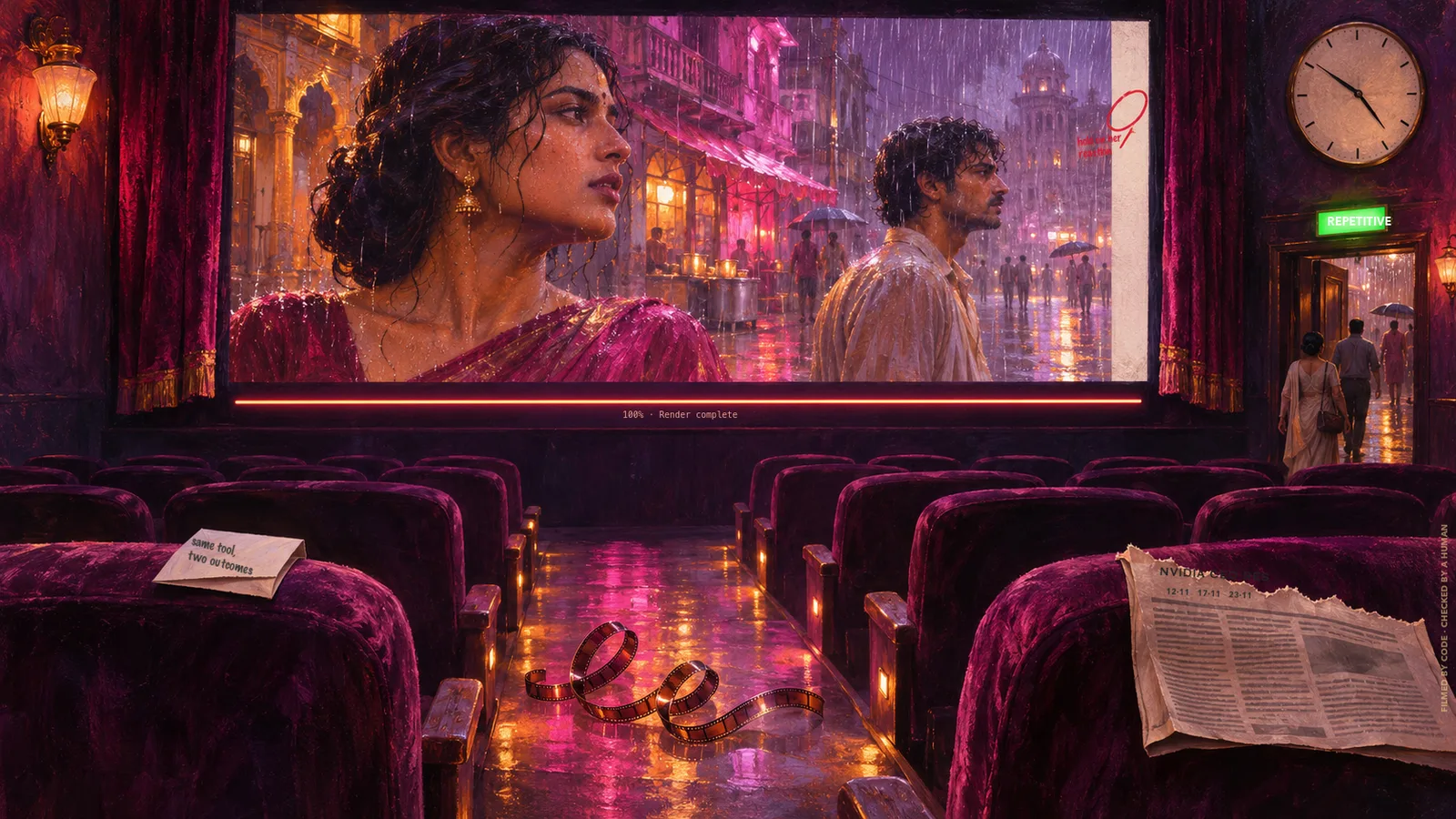
Making a video got close to free this year. Making a good one costs what it always did. The evidence for that comes mostly from the companies selling the tools.
In the GPT-6.2 launch post, OpenAI reported that in two tests its models "were more likely to omit mentioning obstacles that blocked their work, such as a missing file or unavailable search tool," and says it added Codex instructions that substantially reduce these omissions. A model that builds your set and sometimes leaves out what blocked it is a production risk, and OpenAI flagged it itself.
Adobe built its agent to put the professional "in the director's chair." According to CMSWire, Firefly also gets a Plan Mode, where the user approves the agent's plan before it starts. The words "Plan Mode" are not in Adobe's release as we read it, so that rests on CMSWire alone. Even so, the vendor shipped an approval gate beside its agent.
Facts age too. Nvidia announced on 12 November that Jensen Huang had resigned as chief executive. On 17 November its board said it "does not intend to reinstate" him. On 23 November he was reinstated, according to Nvidia's SEC filing of that day. A film built on the 17 November version would have been wrong six days later without a broken frame in it. Each snapshot was true on the day it was written, and a 28 November roundup still put the reinstatement on "Thursday, November 26," which is wrong. Our own 19 November film on the resignation predates it and is out of date.
Our own work taught us the same thing. Monsoon Delivery, the Godot game we built with Claude Code, passes 973 automated tests, and I still called it boring on camera. The tests checked that it worked; none could check that it was good. And when we researched this issue across four AI engines in six parallel runs, each found something the others missed, and one invented two links that led nowhere: an Adobe blog address and a TechCrunch article.
The strongest objection is that the agent can check its own render, and Google says Carbon does. That helps with what the agent was asked to look for. A self-check with no notion of "boring" would have passed Monsoon Delivery too.
This is what AI Reliability Engineering means for video. The camera is code now. Direction is the new editing: it starts with a brief and ends with someone who checks the cut against that brief, and against the date, before it ships.
Part 3 · The toolbox, and what we built
Where I would start, if you want to make video this way:
HyperFrames (HeyGen). Apache-2.0, built for agents; install the skills with npx skills add heygen-com/hyperframes. Its reverse skill rebuilds an existing video as an editable project and checks it frame by frame against the original. It is also the renderer we build on.
Remotion. The React engine with the most installs. Free for individuals, non-profits and for-profits up to three employees; larger companies need a licence, and GitHub reads it as custom. Read it before building a business on it.
Blender with an MCP bridge. The community bridge (mcp-for-blender, MIT) lets Claude Code, Codex, Antigravity and others drive a live Blender, and Google's Neon lab-bench demo used it. It is not made by Blender and runs code an agent wrote inside your session, so save first and start in a scratch scene.
An FFmpeg toolkit for agents. ffmpeg-skill has 42 tools with a machine-readable contract: cuts, captions, loudness, platform exports. Those are steps where an edit can go wrong unnoticed; a tool that reports what it did gives you something to check.
rea-video. It breaks a video down shot by shot into an open VIDEO.md format, useful for studying a reference and, I think, for checking what your agent made. It is not the REA project.
Instagram Edits Desktop or DaVinci Resolve 21.1. A real editor an agent can drive, which you then finish by hand. Blackmagic has not published how Resolve's integration works, so test before you promise a client anything.
Worth watching: OpenMontage (AGPL-3.0, copyleft) and OpenFilm (pre-1.0).

From our lab
We build in exactly this space, so read this part knowing that.
brief2mp4, with brief2motion in the same install, is our free MIT skill for Claude Code and Codex (github.com/qualixar/brief2mp4). You write a brief and get a finished MP4 (a motion graphic, explainer, documentary, Short or Blender animation), checked against every line of the brief before it calls itself done. The same install builds animated websites and learning pages, checked in real Chrome. This month it went from version 0.3 to 0.8 in eight days and from 30 to 82 art forms, with a free 156-page guide. The proof is on film: a sourced six-minute documentary from one brief, one kite in 24 art styles, a shadow-puppet film with its own website, and the three-model contest. One limit: the check runs against the brief, so a weak brief passes a weak film.
Craft Studio Setup (github.com/qualixar/craft-studio-setup, MIT) installs thirteen free, open-source Storytold apps with one command, alternatives to Word, Excel, PowerPoint, a PDF editor and Photoshop-style tools, and connects them to Claude Code and Claude Desktop. Every download is checked against a pinned SHA-256. It is a small repo, and the "own your tools" idea made practical.
Coming next week: raw2post
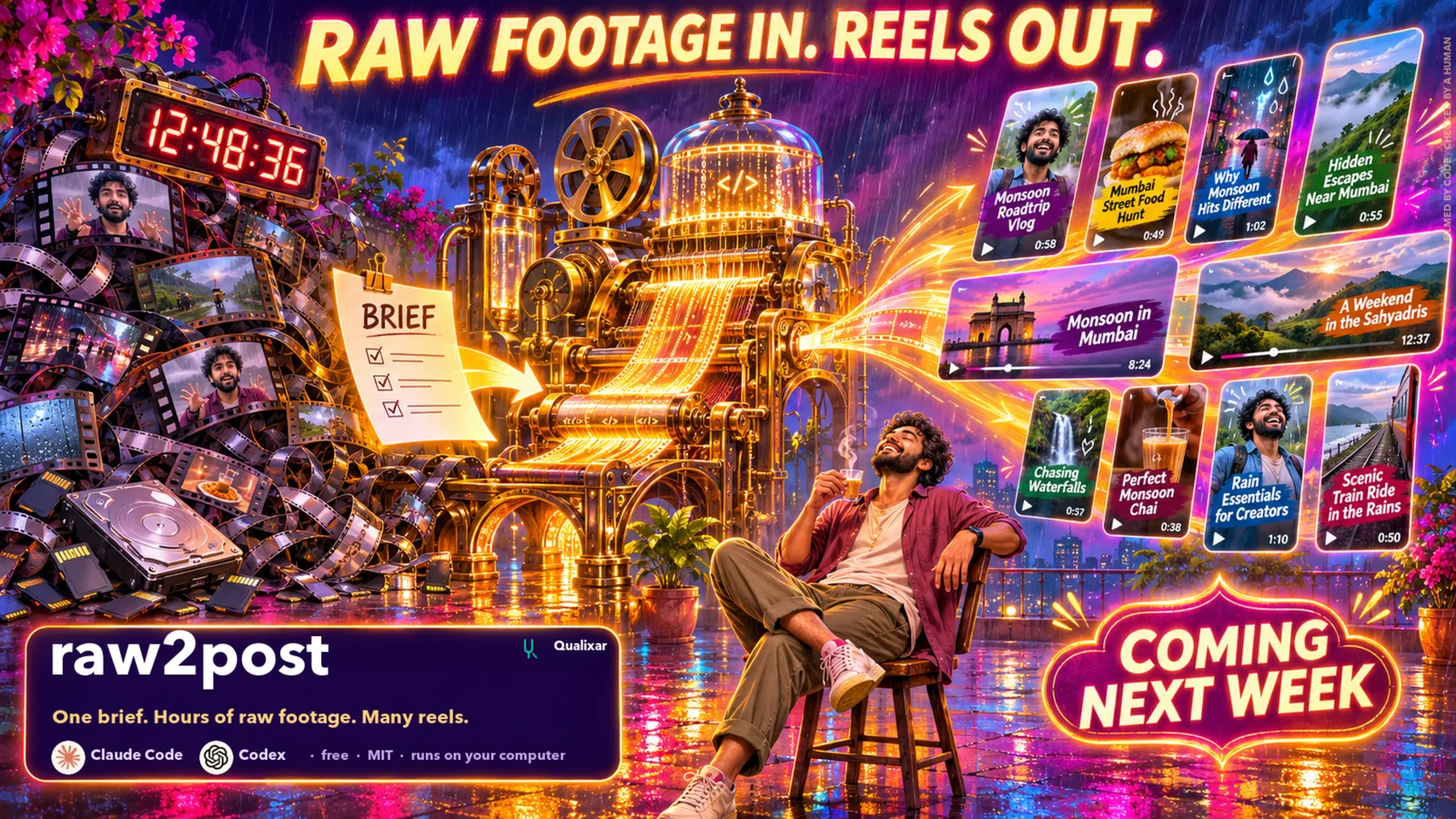
This is the problem we have spent the last few weeks on. A creator today juggles a stack of tools to turn footage into posts: one to cut, one to caption, one for effects, another for every platform's format. With Claude Code or Codex in the room, that should be one conversation.
raw2post is built for exactly that. You give it your raw footage, hours of it if that is what you have, and say what you want in plain words, in English, Hinglish or Hindi. It cuts, captions, adds the effects and motion graphics, and exports for Reels, Shorts and YouTube, so one long recording can become several reels and cut-downs. It is free, open source under MIT, and runs on your own computer.
brief2mp4 makes a video from a brief. raw2post makes many from the footage you already shot. It is not available yet; we launch it next week, and the next issue will show it working on real footage.
Three things for Monday
Write the acceptance test before you write the prompt: what the viewer must see, hear and understand by the end. A tool cannot invent that for you, and it gives every later check something to check against.
Watch every render at full size, at every cut. Flicker, clipping and wrong type hide in thumbnails. If your pipeline is deterministic, render the single frame at the cut and look at it.
Put a date on every number you publish, and look at it again before you post. Nvidia's story, and every star count in this post, will not hold still.
Where the evidence stops
We have no controlled comparison between code-built and model-generated video, so the frame-412 argument stays a reading. Anthropic's montage names no tools. Creator view counts are self-reported, and tutorial views measure interest in learning, not reach. There is no public data on editors or motion designers losing work in this window.
Varun Pratap Bhardwaj · varunpratap.com · Qualixar · @varunPbhardwaj · github.com/qualixar
Sources
Read 28 November 2026. Several sites block automated fetches; those pages were read in a browser session.
Anthropic. Claude Motion launch · Motion help · Runway on Motion · HyperFrames connector · Opus 5.5 · Fable 5.2 · @claudeai thread · Karpathy · OfficeChai Opus roundup
OpenAI. GPT-6.2 Astra and Sol · two-frame room video · @OpenAIDevs thread · Images 2.6
Google. Gemini 4 Carbon · Carbon in Antigravity · Gemini 4 Neon · Neon in Antigravity
Mechanism and arenas. HyperFrames determinism docs · AA-3D leaderboard · AA-3D launch · AA-3D method · AA video arena · Arena text-to-video, 8 Nov
Editors. Edits Desktop, The Verge · Adobe MAX release · Adobe, 8 Sep · After Effects AI Assistant · CMSWire on MAX · Resolve 21.1 · CapCut · Descript · Avid · Apple MCP, 9to5Mac · Adobe Q3 results · Citi downgrade, TIKR
Open stack. HyperFrames · OpenMontage · Remotion · Manim · Manim Community · Blender MCP · rea-video · ffmpeg-skill · OpenFilm · REA · PhotoCraft · Craft Anything · FilmCraft
Creators, jobs, policy. Digiday, 19 Aug 2025 · Tubefilter, 13 Jul · Upwork · Challenger, October · tutorials: 630,291, 540,618, 353,587 · filmmaker's Resolve post
Other events. Nvidia CEO transition · Nvidia 8-K press release of 23 Nov (SEC) · SCMP on the board · Rockstar, GTA VI
Ours. brief2mp4 · brief2mp4 guide · Craft Studio Setup · Monsoon Delivery
Varun Pratap Bhardwaj builds AI Reliability Engineering tools at Qualixar. ORCID 0009-0002-8726-4289