GPT-6 Astra Is Not the End of the AI Race. It Changes the Architecture of How We Work With AI
GPT-6 Astra hit 99.9% on ARC-AGI-3 with a provider adapter, but 62.7% under the Standard harness. Here is the benchmark reality and the practical guide to Astra, Sol, Terra, Luna, Codex and Hermes.
Why 99.9% does not mean “AGI solved,” why 62.7% may be the more important number, and how to actually use Astra, Sol, Terra, Luna, Codex and Hermes without wasting your subscription
Research status: verified against OpenAI, ARC Prize, Artificial Analysis and Hermes Agent documentation on 5 September 2026. Product entitlements are changing during rollout; revalidate plan access immediately before publication.
By Varun Pratap Bhardwaj · @varunPbhardwaj · Qualixar AI Reliability Engineering
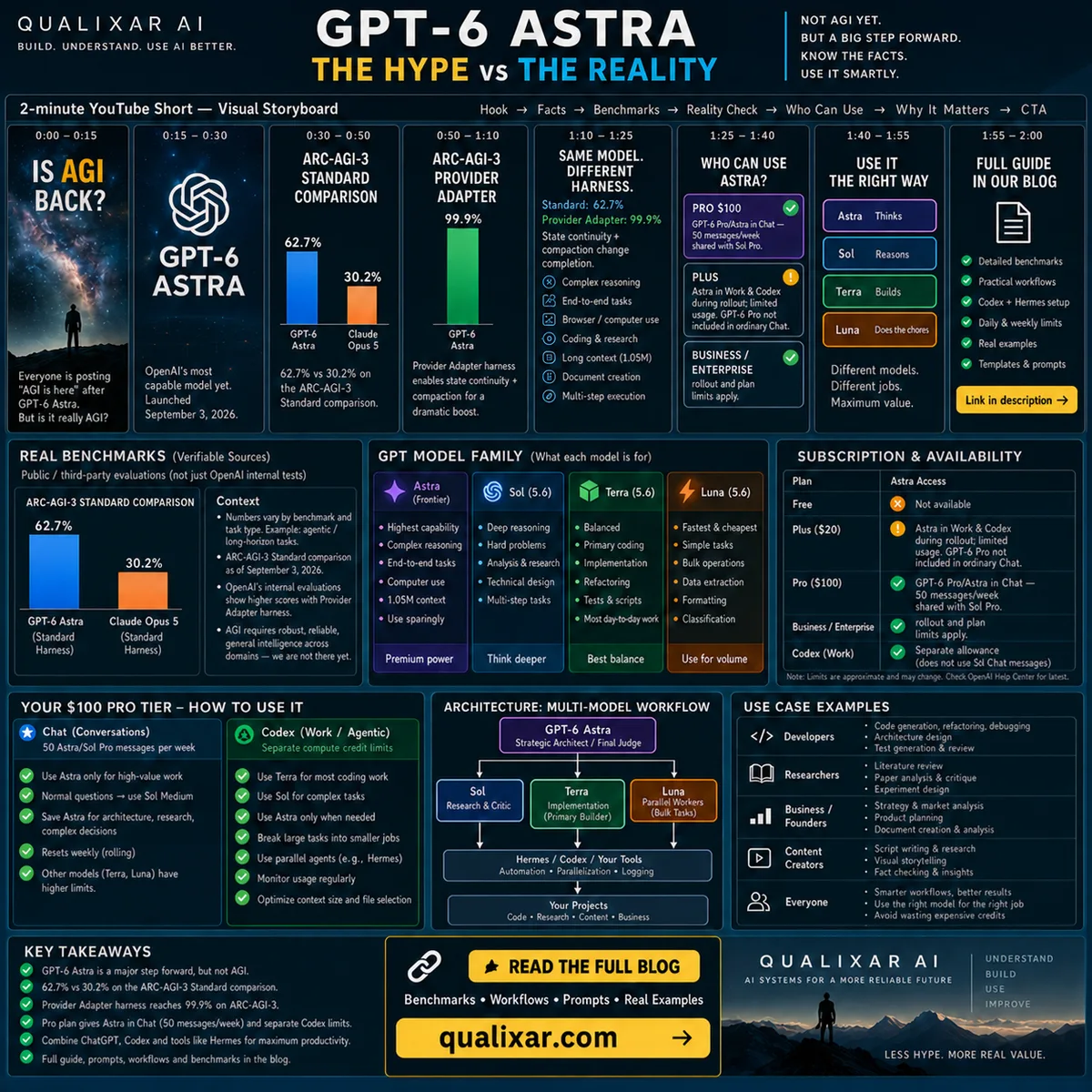
OpenAI released GPT-6 Astra in September 2026 and immediately gave the AI industry the kind of headline it loves: a new model generation, a near-saturated “AGI” benchmark, substantially stronger computer use, and a claim that the frontier is shifting again.
The number that detonated across social feeds was 99.9% on ARC-AGI-3.
At first glance, the story seems almost too clean. The benchmark name contains “AGI.” Previous frontier models were dramatically lower. Astra appears to jump to essentially perfect performance. If you are building a thumbnail, an X post, or a breathless reaction video, the obvious conclusion is irresistible: GPT-6 just solved an AGI benchmark; AGI is here.
That conclusion is not supported by the evidence.
The real story is more complicated, more useful, and—if you build AI systems—more important.
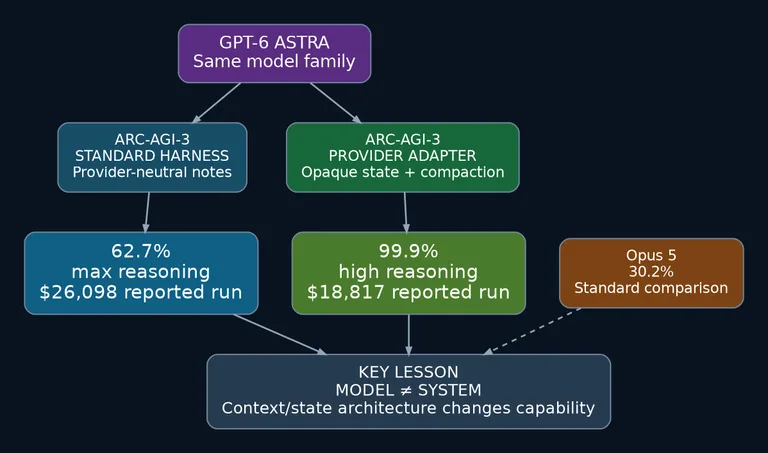
GPT-6 Astra did achieve a 99.9% ARC-AGI-3 result using ARC Prize’s Provider Adapter harness. But when ARC Prize ran Astra through its Standard harness, designed as a minimal provider-neutral interface for cross-provider comparisons, Astra’s best result was 62.7%.
Claude Opus 5 was reported around 30.2% in the Standard-harness comparison. GPT-5.6 Sol was dramatically below Astra on ARC-AGI-3. The 62.7% result is therefore not a disappointment. It is an extraordinary result.
But the gap between 62.7% and 99.9% changes the interpretation.
The Provider Adapter preserves provider-specific opaque reasoning state between calls and uses compaction during longer conversations. The Standard harness leaves the model responsible for deciding what visible notes to carry forward. ARC Prize reports that the Provider Adapter runs were not merely more successful: across comparable solved game/reasoning pairs they were about 3.66× faster by aggregate recorded elapsed time and used 49% fewer total tokens.
Same model family. Different execution architecture. Radically different outcome.
That is the part of the Astra launch that deserves much more attention than the AGI shouting match.
The model is no longer the whole AI system.
Context management matters. State continuity matters. Memory matters. Compaction matters. Tools matter. Execution environments matter. Agent scaffolding matters. Review loops matter. Cost controls matter.
A frontier model inside a bad system can waste its intelligence. A frontier model inside a disciplined system can behave like a qualitatively more capable worker.
That is the architecture shift this article is about.
1. Start with the benchmark honestly
ARC-AGI-3 is not a standard static question-answer benchmark. It tests an agent in unfamiliar interactive environments. The system must explore, infer mechanics, identify goals and execute plans. That makes it especially relevant to the direction frontier models are moving: away from one-shot text generation and toward repeated action in software environments.
ARC Prize describes capabilities such as exploration, modeling, goal identification, planning and execution. The agent does not simply retrieve a memorized answer. It needs to build a useful representation of a novel environment and act on that representation.
This is why Astra’s performance is meaningful.
ARC Prize observed Astra constructing compact symbolic world models, tracking rules and state, and using increasingly effective representations as it learned how an environment worked. In richer scaffolds, this class of agent behavior can include parsers, planners, search procedures and task-specific tooling.
That is closer to what we mean when we talk about an AI agent: not just a system that can say something correct, but one that can maintain an objective across many steps, revise its model of the world and make progress through action.
The benchmark therefore matters.
But the exact evaluation condition matters too.
The Standard harness
ARC Prize’s Standard harness is designed to provide a common minimal interface. The model gets what it needs to interact with the environment, but it decides what to preserve in visible notes across turns.
Astra’s best reported Standard-harness score is 62.7% at max reasoning.
That is the cleanest Astra number to use when you are making a cross-provider ARC-AGI-3 comparison.
The Provider Adapter harness
The Provider Adapter uses provider-specific context-management features. For Astra, ARC Prize says this includes preserving opaque reasoning state between requests and using compaction for longer conversations.
The best observed result is 99.9% at high reasoning.
That result is real. It should not be dismissed. But it answers a different evaluation question:
How well can Astra perform when it is allowed to use the context-management architecture designed around it?
This is a legitimate and practically important question. Real deployed agents do not live in a perfectly provider-neutral vacuum. They have memory systems, context managers, cache behavior, tools, runtimes and state-retention mechanisms.
What is not legitimate is showing the 99.9% number next to a competitor’s provider-neutral result and pretending the harness conditions are identical.
The honest presentation is stronger anyway:
Astra is very strong under a neutral harness—and almost saturates the benchmark when given its provider-specific state-management machinery.
That tells us something about the model and something about AI-system design.
2. Why “62.7% vs 99.9%” may be more important than “99.9%”
For years the AI industry optimized for the model card.
Which model has the highest score?
Which model has the most parameters?
Which model wins MMLU, GPQA, SWE-bench, ARC or some new composite index?
Those comparisons remain useful, but long-running agents introduce another dimension: system capability.
A minimal language-model loop looks like this:
Prompt
  ↓
Model
  ↓
Answer
A serious agent looks more like this:
Goal
  ↓
Planner
  ↓
Model
  ↓
Context manager
  ↓
Retained state / memory
  ↓
Tools
  ↓
Browser / terminal / professional software
  ↓
Observation
  ↓
Model
  ↓
Recovery / compaction / review
  ↓
Next action
  ↓
...
A one-shot answer can be judged largely by the quality of a single model invocation.
A four-hour agent run may contain hundreds of dependent decisions. It accumulates state. It discovers facts. It creates hypotheses. It makes mistakes. It changes files. It receives tool output. It needs to distinguish a durable decision from a transient observation. It needs to remember what failed without dragging every irrelevant token forever.
This is where raw model intelligence stops being enough.
A system can fail because it forgets what it already learned.
It can fail because it keeps a failed hypothesis alive for another fifty turns.
It can fail because its context has become so large that relevant state is buried under logs and dead ends.
It can fail because it repeatedly re-explores the same area.
It can fail because one successful subtask violates an invariant the broader system depends on.
It can fail because no component decides what deserves to become canonical state.
The ARC harness gap gives us a concrete example of how much those surrounding mechanisms can matter.
The correct lesson is not “provider adapters are cheating.”
The correct lesson is:
When models become agents, context engineering becomes part of capability engineering.
That is a much more durable insight than any launch-week leaderboard position.
3. Does GPT-6 Astra prove AGI?
No single benchmark can settle that question because the field still lacks a universally accepted operational definition of AGI.
Some definitions emphasize broad human-level competence across cognitive tasks. Some emphasize economic work. Some emphasize transfer learning and rapid adaptation. Some require autonomy. Some require the ability to learn new tasks efficiently. Some definitions are so broad that they become philosophical rather than measurable.
This definitional problem is exactly why a benchmark name should not be treated as a scientific declaration.
ARC Prize itself is explicit: saturating ARC-AGI-3 is not proof of AGI. Its environments are bounded, deterministic and closed-ended. The benchmark is designed to measure important aspects of generalization and agentic intelligence, not the full open-ended complexity of the real world.
That does not make the benchmark weak. It makes the interpretation disciplined.
The right conclusion is neither:
“Astra is just marketing.”
nor:
“AGI is solved.”
A better conclusion is:
Astra is evidence that frontier language models are becoming substantially more capable general-purpose digital agents.
That transition matters economically even if we never agree on the exact day the word “AGI” should be used.
If an agent can operate software, browse, debug, analyze data, build a useful model of an unfamiliar environment, use tools, maintain state and complete long professional workflows, it can change how knowledge work is organized long before philosophers settle a definition.
The practical question for builders should therefore be:
What can we now delegate reliably and economically that we could not delegate six months ago?
That is measurable.
4. The independent benchmark reality check
Every frontier-model launch should be evaluated through at least two lenses:
- What does the provider report under its own evaluation setup?
- What happens when independent evaluators run models under shared methodologies?
OpenAI’s Astra launch table is impressive. But it is still a vendor launch table.
Artificial Analysis adds an important reality check. Its current Intelligence Index places Astra around 61. That is frontier-level performance, but it does not show a universal step-function jump over every other frontier model. Some competing models remain ahead on that aggregate.
Artificial Analysis’s more interesting Astra finding is in its Coding Agent Index. Astra reaches approximately 67, around the leading frontier band, while showing meaningful token-efficiency gains in some configurations.
This gives us a more nuanced picture:
- Astra is not two times more generally intelligent than every competitor.
- Astra does not win every benchmark.
- Astra looks especially strong where intelligence has to be converted into multi-step action.
- Efficiency per successful task may be as important as raw score.
This distinction matters because agents operate under budgets.
A model that is five percent better but three times more expensive may be the wrong default worker.
A model that is slightly better while using half the tokens may materially change a long-running workflow.
Once agents run for hours, token efficiency becomes a capability.
So do latency, recovery, context discipline and tool reliability.
5. Where Astra genuinely looks exceptional
The Astra story becomes strongest when we look at tasks requiring action.
Computer use
OpenAI reports 72.6% on OSWorld 2.0 offline, compared with 65.7% for GPT-5.6 Sol and a reproduced 70.2% for Claude Opus 5 in the comparison shown.
OpenAI also reports Astra completing its OSWorld latency simulations in substantially less time than Sol.
Computer use matters because modern knowledge work lives inside interfaces: browsers, spreadsheets, CRMs, IDEs, terminals, CAD tools, data-science environments, ticketing systems, cloud consoles and internal enterprise applications.
A model can be brilliant at text and still be a weak worker if it cannot reliably operate the software where work actually happens.
Professional automation
Astra scores 41.4% on AutomationBench in OpenAI’s table, compared with 18.1% for Sol and 26.9% for Opus 5.
The absolute score is important: 41.4% is not “solved.” There is still enormous headroom.
But the relative jump signals meaningful progress in heterogeneous workflows.
Scientific terminal work
On Terminal-Bench Science 0.1, OpenAI reports Astra at 64.6%, versus 22.4% for Sol, 52.6% for Claude Fable 5.1 and 30.0% for Opus 5.
This is one of the clearest generational improvements in the launch table.
Scientific workflows require more than factual recall. They require code execution, data handling, iterative analysis, simulation, model fitting and interpretation. That is exactly the kind of multi-step environment in which an agent’s ability to maintain a coherent plan matters.
Terminal engineering
On Terminal-Bench 4.0, Astra reaches 57.9%, compared with 37.3% for Sol and 52.6% for Opus 5.
Again, the story is not “everything else is obsolete.” The gap to other frontier systems is meaningful but not absolute.
Advanced mathematics
OpenAI reports 97.6% on FrontierMath Tier 4 v2.
That is an extraordinary academic result, but it should sit beside other benchmarks rather than become a universal intelligence proxy.
6. Where Astra does not justify a universal-superiority narrative
A credible model analysis should include losses and narrow gaps.
BrowseComp
Astra: 91.5%.
Sol: 90.4%.
Opus 5: 90.8%.
This is effectively a frontier cluster. Astra is not creating a new universe of capability here.
GPQA Diamond
Astra: 96.0%.
Sol: 94.6%.
Opus 5: 93.7%.
Again, excellent, but the gap is modest because the frontier is already near saturation.
Humanity’s Last Exam with tools
OpenAI’s table reports Astra at 57.2%, while Claude Fable 5.1 is 65.0% and Opus 5 is 63.6%.
Astra loses.
That one row is editorially valuable because it destroys the lazy narrative that a new generation number means universal dominance.
Strong models have capability profiles.
The future is likely to be heterogeneous.
7. The model stack should be treated as an economic hierarchy
The biggest operational mistake after a frontier-model release is making the newest model the default for everything.
If you need to decide whether a cross-system architecture is safe, Astra may be worth its cost.
If you need to rename twenty files, Astra is absurd.
The right question is not:
Which model is best?
The right question is:
What is the least expensive model that reliably clears the quality bar for this task?
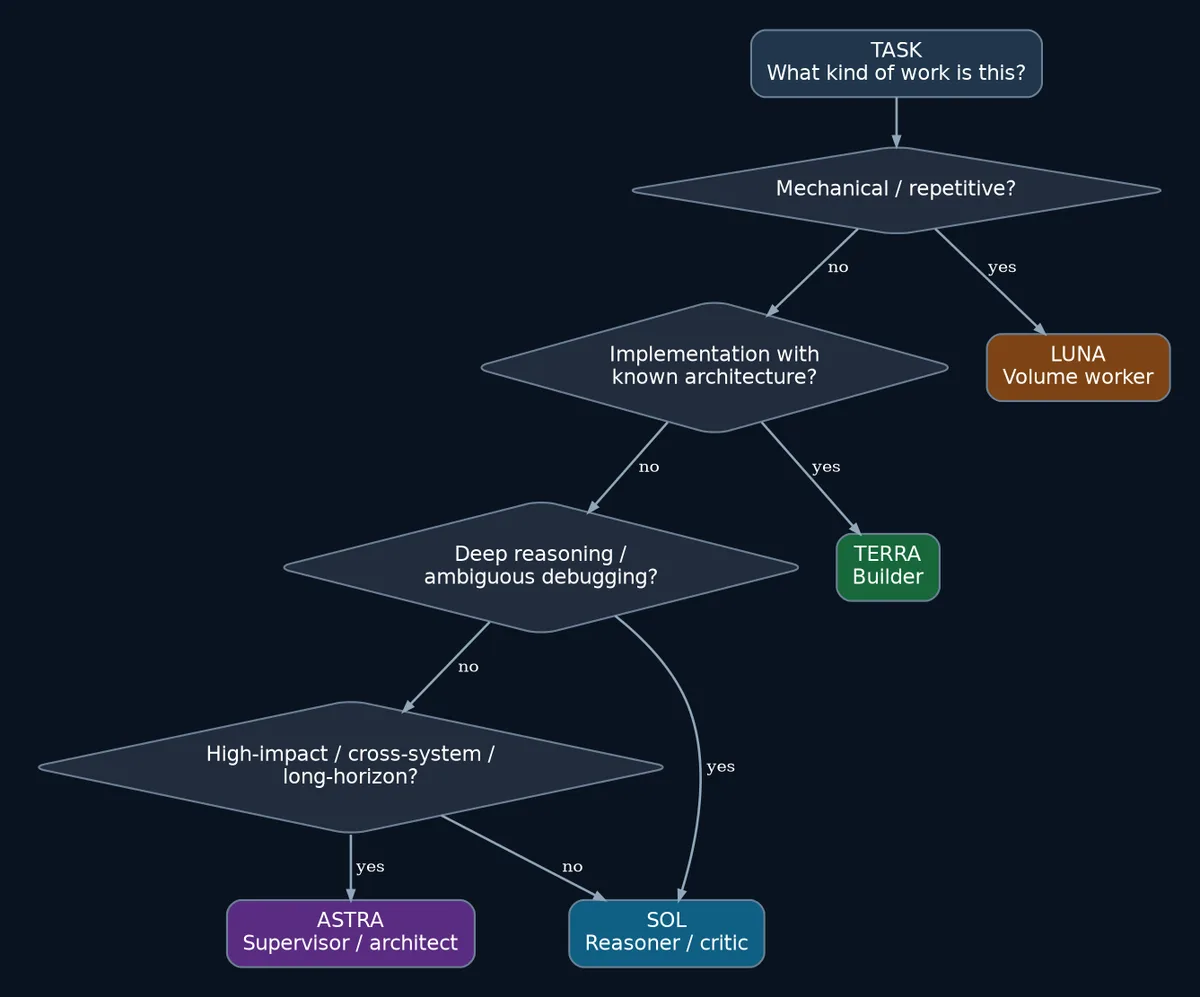
For OpenAI’s current stack, a useful mental model is:
Astra thinks about the system. Sol reasons about the problem. Terra builds the solution. Luna does the chores.
GPT-6 Astra — supervisor
Use Astra for high-leverage uncertainty:
- architecture
- difficult end-to-end workflows
- high-impact decisions
- complex cross-system debugging
- long-horizon autonomous work
- advanced computer-use tasks
- final adversarial review
- scientific or professional tasks where failure is expensive
GPT-5.6 Sol — reasoner
Use Sol for:
- deep analysis
- research synthesis
- hard debugging
- technical design
- critique
- mathematical reasoning
- complex narrative structure
- evaluating trade-offs
GPT-5.6 Terra — builder
Use Terra for:
- implementation
- refactoring
- routine coding
- tests
- documentation
- migrations
- structured transformations
- medium-complexity engineering
GPT-5.6 Luna — volume
Use Luna for:
- classification
- extraction
- formatting
- repetitive code edits
- boilerplate
- file triage
- batch transformations
- low-risk mechanical work
This is not a moral hierarchy and it is not a permanent benchmark ranking.
It is a routing policy.
8. API economics explain why routing matters
OpenAI’s current API pages list the following approximate token prices:
| Model | Input / 1M | Cached input / 1M | Output / 1M |
|---|---|---|---|
| GPT-6 Astra | $10 | $1 | $50 |
| GPT-5.6 Sol | $4 | $0.40 | $20 |
| GPT-5.6 Terra | $2 | $0.20 | $12 |
| GPT-5.6 Luna | $0.20 | $0.02 | $1.20 |
You do not need to be an API customer for this table to teach you something.
It shows the economic shape of the model family.
Astra is not designed as a bulk worker.
Luna is not designed as your supreme architect.
Terra exists because most production work benefits from a balance of capability and cost.
Sol exists because reasoning depth still has a premium.
Model routing is therefore not a clever optimization. It is the basic way to avoid converting a premium subscription into a three-day quota burn.
9. A million-token context window is capacity, not a target
Astra, Sol, Terra and Luna have model pages listing a 1.05M-token context window.
That number is impressive. It is also dangerously easy to misunderstand.
A large context window means the model can process a very large working set.
It does not mean every session should grow until it is close to one million tokens.
Imagine an engineering session that has accumulated:
- architecture discussion
- full repo scans
- terminal logs
- five failed patches
- two abandoned strategies
- complete test output
- repeated explanations
- generated documentation
- copied tickets
- design screenshots
- old debugging hypotheses
After enough turns, the transcript stops behaving like memory and starts behaving like a landfill.
Relevant facts are still inside it—but they have to compete with everything else.
The more durable pattern is to periodically create canonical state artifacts:
ARCHITECTURE.md
DECISIONS.md
CURRENT_STATE.md
KNOWN_FAILURES.md
TEST_STATUS.md
NEXT_STEPS.md
Then start the next execution phase from those artifacts and the current repository state.
That is not “losing context.”
It is engineering context.
OpenAI’s Sol/Terra/Luna API pages also state that prompts above 272K input tokens have higher long-context pricing in the API. Even when your subscription metering is not identical to API billing, the principle is obvious: large context is expensive infrastructure.
Use it when it creates value.
10. The ARC result teaches the opposite of “keep everything forever”
The Provider Adapter’s success does not mean infinite raw transcript is ideal.
It uses state continuity and compaction.
That is a critical distinction.
Raw conversation history is not the same thing as useful memory.
Suppose a senior engineer joins a project after six months. Would you give them every Slack message, terminal output and failed patch and call that “context”? Or would you give them:
- the architecture
- current code
- decisions
- constraints
- unresolved risks
- recent incident history
- next milestones
Of course you would compact.
Agents need the same discipline.
The objective is not to remember everything.
The objective is to preserve what changes future decisions.
11. For a developer: use Codex as the execution plane
Chat is excellent for discussion, research and strategic reasoning.
Software engineering needs another layer: a runtime that can inspect repositories, execute commands, run tests, modify files, observe failures and iterate against evidence.
That is where Codex belongs.
A clean division is:
CHAT
strategy / research / architecture
   ↓
CODEX
repo / terminal / implementation / tests
   ↓
EVIDENCE
   ↓
CHAT or ASTRA
review / decision if the change is high-impact
The mistake is starting every Codex task with your most expensive model and maximum reasoning.
A better escalation path is:
routine implementation → Terra
hard implementation → Terra High
reasoning bottleneck → Sol
system-level ambiguity → Astra
mechanical batch work → Luna
The exact UI options will evolve. The principle survives product changes.
12. Astra should be your supervisor, not your typist
Consider a major software release.
The naïve workflow is:
Astra writes architecture
Astra implements
Astra writes tests
Astra debugs
Astra reviews itself
Astra ships
That wastes frontier capacity and creates a weak review structure.
A stronger pattern is:
Astra
architecture + risk model
   ↓
Terra
implementation
   ↓
Tests / runtime evidence
   ↓
Sol
adversarial review
   ↓
Terra
corrections
   ↓
Astra
release-level judgment, only if justified
Astra spends cognition where judgment has leverage.
Terra spends capacity where implementation volume matters.
Sol creates an independent reasoning checkpoint.
Luna can scan, classify and process volume around the edges.
This architecture works for one developer or a large team.
13. For a researcher: separate hypothesis generation from verification
A research workflow should not ask one frontier model to generate a theory, write its proof, run experiments and certify that its own work is correct.
Use role separation.
Example:
Astra → research question / conceptual holes
Sol → literature reasoning / competing hypotheses
Terra or Codex → experiments / implementation
Luna → extraction / classification / bookkeeping
Sol → analyze results
Astra → hostile reviewer / novelty check
The value is not only cost.
Role separation reduces correlated self-confirmation.
A critic should have a different prompt, different context and preferably a different execution path from the author.
14. For a content creator: spend frontier intelligence on thesis, not commas
Content creators will also waste Astra if they use it as an expensive copywriter.
Astra’s highest-value question is not necessarily:
“Write me a 2,000-word script.”
It may be:
What is the non-obvious thesis?
Where will a smart viewer stop watching?
Which claim is most attackable?
What evidence changes the story?
Then Sol can build the narrative, Terra can build production manifests and Luna can process metadata, captions, alternate hooks and repetitive assets.
Example:
Research → Sol
Thesis attack → Astra
Script → Sol
Asset manifest → Terra
Metadata variants → Luna
Final editorial challenge → Astra only if the video is strategically important
This produces more content per unit of frontier capacity without lowering quality where it matters.
15. For a founder or CEO: use Astra to reduce uncertainty
A founder should not spend frontier-model messages asking for generic motivational summaries.
The economic value of Astra is reducing uncertainty around decisions with meaningful downside or upside.
Examples:
- Should we enter this market?
- Which architecture creates a platform rather than a feature?
- What assumption in our product strategy is most likely wrong?
- Which regulatory or security dependency could block deployment?
- What does a hostile competitor do next?
- What would make this investment thesis fail?
A useful architecture is:
Founder
   ↓
Astra — challenge assumptions
   ↓
Sol — gather/analyze evidence
   ↓
Terra/Work — build artifacts and execute
   ↓
Evidence
   ↓
Astra — decision synthesis if stakes justify it
The model is no longer a chatbot.
It becomes part of a decision system.
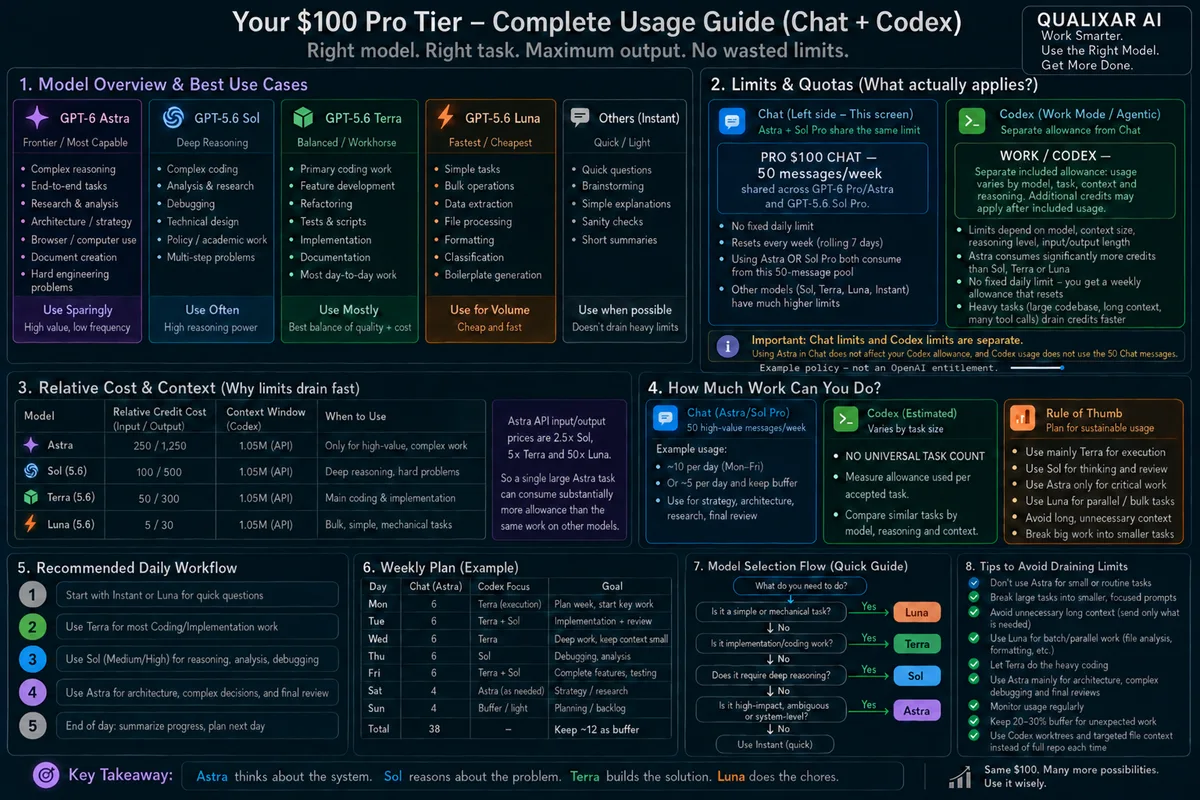
16. ChatGPT Pro $100: understand the Chat bucket correctly
As of the current OpenAI Help Center snapshot, GPT-6 Pro in Chat is powered by Astra.
For Pro $100, GPT-6 Pro and GPT-5.6 Sol Pro share one 50-message weekly allowance in Chat.
That detail changes how you should behave.
If you care about preserving Astra access, do not casually use Sol Pro for tasks that ordinary Sol Medium/High can solve. Sol Pro and Astra draw from the same Pro-model weekly bucket on the $100 tier.
The ordinary reasoning choices are different. OpenAI says manually selecting Medium, High or Extra High uses GPT-5.6 Sol. Those are not identical to the separate Sol Pro model option.
A practical Chat policy is therefore:
Instant / automatic reasoning → default conversation
Sol Medium/High → serious normal reasoning
Astra / GPT-6 Pro → scarce, high-impact work
Sol Pro → use only when there is a concrete reason to spend from the shared Pro-model bucket
Fifty weekly frontier messages can be a lot if each one resolves a high-leverage decision.
They are almost nothing if you use them for rewrites and basic explanations.
17. Work and Codex are a different allowance domain
OpenAI states that Chat and Work/Codex have separate usage structures.
Astra in Work and Codex uses the plan’s included agentic allowance as rollout reaches the account. Pro $100 and Pro $200 users can use their full existing Work/Codex allowance with Astra; Plus receives limited Astra use in Work/Codex during rollout.
The key point is that Work and Codex are not another Chat bucket measured in simple messages.
Usage depends on the model, task size, input/output, reasoning settings and speed mode.
This is why a developer can feel like “I only sent a few prompts” and still burn a large fraction of the weekly agentic allowance.
An agent prompt is not one unit of work.
It can trigger a long execution trajectory.
The right metric is not message count.
The right metric is completed-work cost.
18. Measure your personal Codex economics
OpenAI cannot give one useful global answer to “how many coding tasks do I get?” because tasks vary by orders of magnitude.
You can create a much more useful measurement yourself.
Before a representative task, record the usage meter.
Example:
Weekly capacity before: 83%
Weekly capacity after: 80%
Task cost: 3 percentage points
Repeat across several comparable tasks.
Suppose five medium engineering tasks cost:
2.1%
2.8%
2.4%
2.6%
2.3%
Median cost: about 2.4%.
If you have 60% remaining, your rough capacity is:
60 / 2.4 ≈ 25 comparable tasks
This is far more useful than counting prompts.
Now you can compare models too.
Run the same task class with Terra and Sol.
If Terra costs half the allowance and succeeds with the same human review time, Terra should become the default.
If Sol costs more but prevents two hours of rework, Sol is cheaper in outcome terms.
The objective is cost per accepted result, not cost per token and not prestige per model name.
19. Manage a weekly agentic allowance like a budget
If your allowance routinely dies on Day 2 or Day 3, stop treating it as an invisible platform limit.
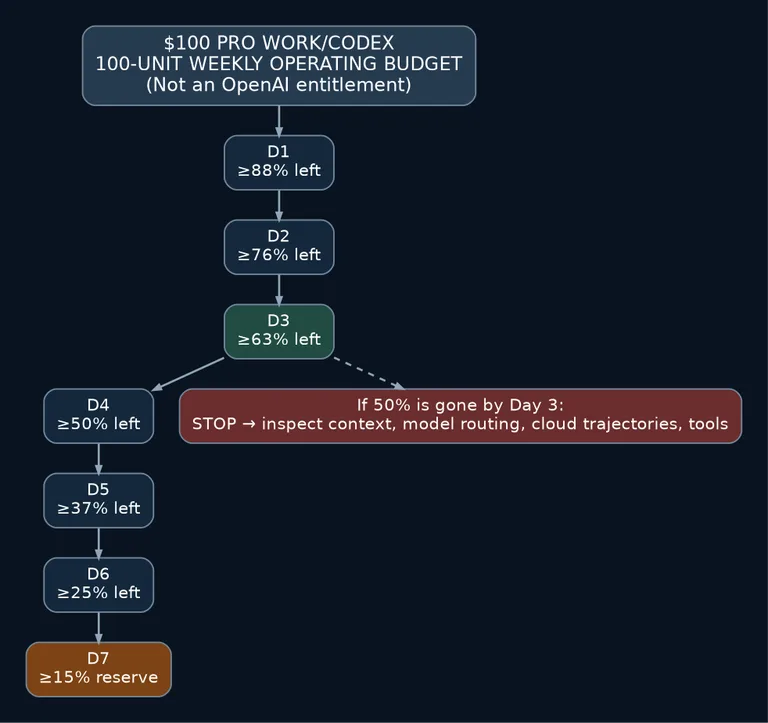
Treat the weekly meter as 100 budget units.
An example sustainable operating policy:
| Cycle day | Target cumulative spend | Desired remaining |
|---|---|---|
| Day 1 | 12% | 88% |
| Day 2 | 24% | 76% |
| Day 3 | 37% | 63% |
| Day 4 | 50% | 50% |
| Day 5 | 63% | 37% |
| Day 6 | 75% | 25% |
| Day 7 | 85% | 15% reserve |
This is not an OpenAI entitlement table. It is an operating discipline.
If you reach 50% spent by Day 3, investigate:
- oversized context
- unnecessary high reasoning
- Sol/Astra used for implementation volume
- long cloud agent trajectories
- repeated repo scans
- too many enabled tools/MCP servers
- verbose outputs
- one giant session doing unrelated jobs
The purpose of the reserve is not to leave paid capacity unused.
The purpose is to avoid becoming powerless when a genuinely difficult problem appears late in the cycle.
20. Plus vs Pro: the rollout is surface-specific
This is one of the easiest things to publish incorrectly because OpenAI’s rollout language is changing quickly.
OpenAI’s broad launch announcement says Astra will become available to Plus, Pro, Business and Enterprise users over the rollout.
The current product-specific Help Center is more precise about surfaces:
- GPT-6 Pro/Astra in ordinary Chat is listed as rolling out for Pro $100, Pro $200, Business and Enterprise.
- Plus is documented as receiving Astra in Work and Codex as rollout reaches the account, with limited usage.
- Pro is documented as receiving Astra in Chat, Work and Codex as rollout reaches the account.
Therefore do not write:
“Plus will never get Astra.”
And do not write:
“Every Plus user can select GPT-6 Pro in Chat today.”
The safe statement is:
Astra is part of the broader Plus rollout, but current access is surface- and rollout-dependent. OpenAI’s Help Center currently lists GPT-6 Pro in Chat for Pro/Business/Enterprise while documenting limited Astra access for Plus in Work and Codex.
Recheck the Help Center on publication day.
21. Hermes does not replace Codex—and that is the wrong comparison anyway
Hermes Agent is interesting because it introduces another orchestration surface.
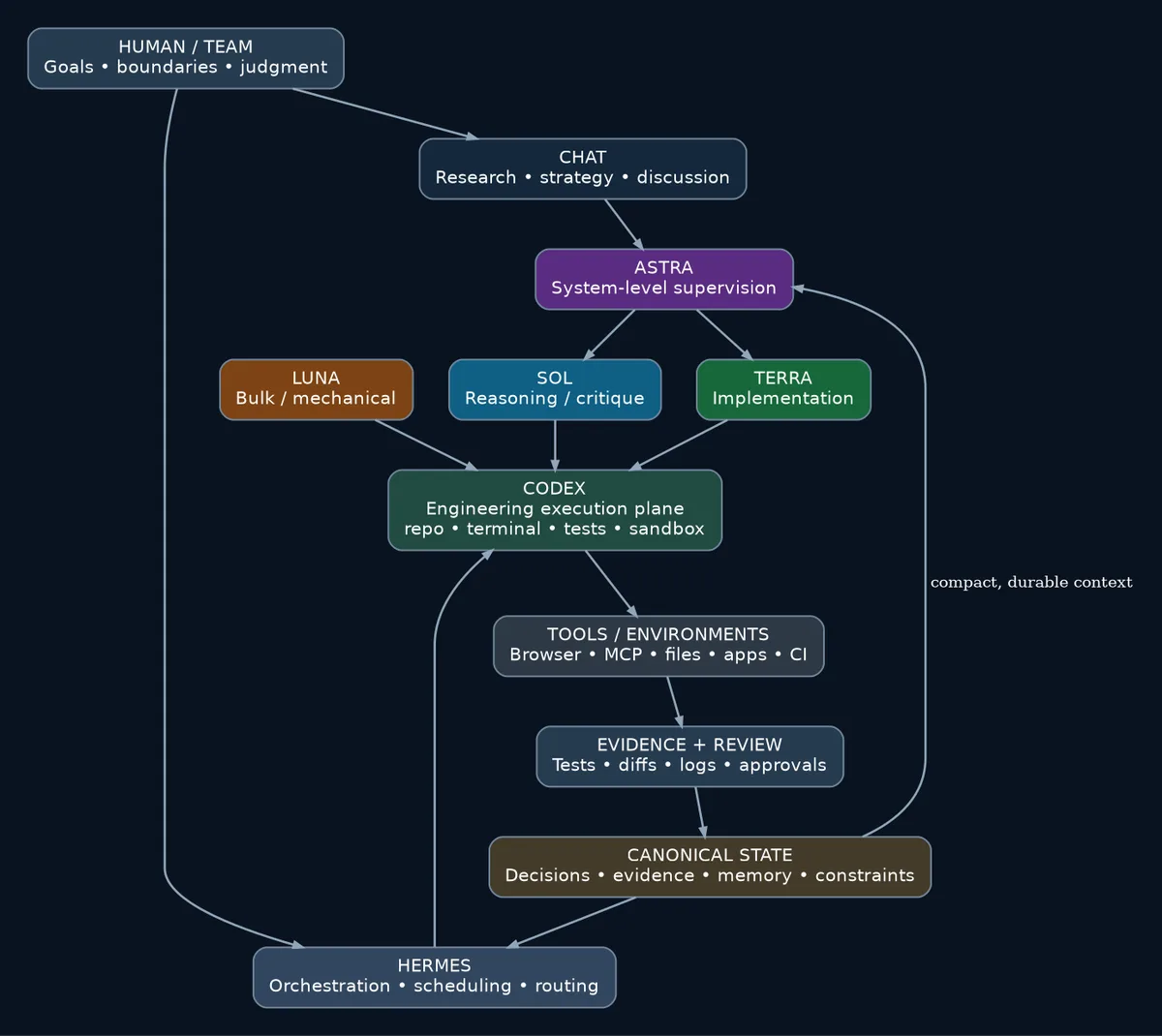
Its official documentation describes an optional Codex app-server runtime. When enabled, eligible OpenAI/Codex turns can run through Codex’s runtime, including terminal operations, structured edits, sandboxing and MCP tooling, while Hermes remains the outer shell for sessions and other orchestration behavior.
That creates a more useful architecture than “Hermes versus Codex.”
Think:
Hermes
orchestration / scheduling / routing
   ↓
Codex app-server
engineering runtime
   ↓
OpenAI model selected for the task
   ↓
repo / terminal / tests / tools
Hermes documentation also says ChatGPT subscription authentication can be used through its openai-codex path.
This is useful.
But do not turn it into a quota loophole story.
The documentation notes that auxiliary tasks can also flow through the ChatGPT subscription when the Codex runtime/provider is used. The right assumption is that the work is metered according to the underlying authenticated runtime—not that Hermes magically creates free extra OpenAI compute.
Use Hermes for orchestration value, not for an unsupported “double your quota” claim.
22. Hermes + Codex + multiple models: where parallelization becomes interesting
The real advantage of an orchestrator is not merely switching the same prompt between models.
It is decomposition.
Most people still use AI serially:
ask → wait → read → ask → wait → read
A multi-agent system can split independent work:
                    Supervisor
                       Astra
                         │
       ┌─────────────────┼─────────────────┐
       ▼                 ▼                 ▼
    Research          Coding           Content
      Sol              Terra              Sol
       │                 │                 │
       ▼                 ▼                 ▼
  evidence          tests/repo         assets
       └─────────────────┼─────────────────┘
                         ▼
                      review
Hermes can provide scheduling, delegation and routing primitives around that pattern. Codex can remain the specialized engineering runtime.
This is where heterogeneous models become an advantage rather than a nuisance.
Astra does not need to write every line.
It can supervise the structure of the work.
23. Parallelization without governance is just faster failure
More agents are not automatically better.
If five agents can modify the same system without clear boundaries, you can create five times the collision surface.
Parallel work needs:
- isolated workspaces or worktrees
- explicit ownership of files/tasks
- merge/review gates
- shared invariants
- cancellation rules
- budget limits
- timeout/stall detection
- durable run logs
- human approval for consequential actions
This becomes more important as models become better at acting.
A weak assistant that writes a bad paragraph is annoying.
A strong agent that confidently changes infrastructure is a security and reliability problem unless the system constrains it.
24. Astra’s cyber capability makes permission architecture non-optional
OpenAI says Astra is the first model it has broadly deployed to reach the Critical cybersecurity capability threshold under its Preparedness Framework.
That should change how sophisticated users think about agent permissions.
The response is not panic.
It is engineering.
Use:
- least privilege
- sandboxed execution
- scoped credentials
- explicit target boundaries
- approval gates for destructive changes
- immutable audit logs
- rollback paths
- network controls
- separation of planning and authorization
The stronger the model, the weaker “the prompt told it not to” becomes as a security control.
A prompt is intent.
A permission boundary is enforcement.
25. The future agent stack needs a control plane, execution plane and memory plane
A useful 2026 architecture looks less like a chatbot and more like a distributed system:
Human / organization
        │
        ▼
Control plane
policy • routing • goals • approvals
        │
        ▼
Supervisor / planner
Astra or another frontier model
        │
  ┌─────┼─────────────┐
  ▼     ▼             ▼
Codex  Hermes      Work/browser
  │      │             │
  ▼      ▼             ▼
models + tools + environments
        │
        ▼
canonical state / memory
        │
        ▼
observability + evidence
        │
        ▼
review / recovery
Notice what this architecture does not assume:
It does not assume one provider wins forever.
It does not assume one model does every job.
It does not treat chat history as memory.
It does not allow every agent unrestricted access.
It treats models as powerful, replaceable compute inside a governed system.
That is a more durable architecture than building your business around whichever model has the best launch-week score.
26. Why memory becomes more important as models improve
A common argument says better models will make memory infrastructure unnecessary.
Astra’s ARC-AGI-3 result points in the opposite direction.
The better the model becomes at using retained state, the more valuable good state becomes.
A weak model with excellent memory is still weak.
A strong model with chaotic state wastes its strength.
A strong model with disciplined context, durable memory, useful tools and bounded execution can become a qualitatively more capable system.
This is why “memory” should not mean “save the conversation.”
A real memory architecture distinguishes:
- transient execution context
- canonical facts
- current decisions
- learned patterns
- security constraints
- user/org preferences
- provenance
- expiration rules
- confidence
- access control
Once agents work across days and projects, those distinctions become infrastructure.
27. Compaction is a governance decision, not only a token optimization
When a system compacts context, it decides what survives.
That is more than compression.
Suppose an agent discovered:
- one API is deprecated
- a customer requirement forbids a certain behavior
- a test failure revealed an architectural invariant
- a previous remediation made production worse
If compaction drops those facts, future behavior can regress even though the raw model is highly capable.
Therefore good compaction should preserve:
- decisions and rationale
- constraints and invariants
- unresolved risks
- evidence links
- failure lessons
- current objective
And it should discard or summarize:
- redundant logs
- repeated explanations
- dead-end hypotheses
- routine tool chatter
- stale intermediate text
The goal is not smaller context at any cost.
The goal is high information density for future decisions.
28. Practical routing examples by profession
Deep software engineer
Default: Terra in Codex. Escalate: Sol for difficult debugging/design. Use Astra: system architecture, unfamiliar large-system failures, release-level review. Use Luna: batch file classification, mechanical checks, repetitive transformations.
Security/SRE engineer
Default: Sol or Terra depending on task. Astra: complex incident synthesis or authorized deep analysis with strict boundaries. Rule: never equate higher model capability with broader permissions.
Researcher
Default: Sol for intellectual work. Astra: research framing and hostile review. Terra/Codex: experiments and analysis pipelines. Luna: extraction/classification.
Founder
Default: Sol for market/product analysis. Astra: strategic uncertainty, architecture and consequential decisions. Work: create finished artifacts. Codex: product engineering.
Content creator
Default: Sol for research/narrative. Astra: thesis, fact-risk attack and final editorial challenge. Terra: asset manifests and production operations. Luna: metadata, variants and bulk transformations.
Enterprise platform team
Use explicit routing policies. Measure cost per accepted outcome. Preserve a frontier escalation pool rather than making the premium model the default for every employee action.
29. Five prompt patterns that spend Astra well
Architecture attack
Inspect the system as a hostile staff architect. Identify hidden coupling, invalid assumptions, missing invariants, recovery gaps, security boundaries and failure amplification. Do not implement until the risk model is complete.
Causal-debugging escalation
We have attempted multiple fixes and local tests pass, but production behavior remains inconsistent. Build a causal model across components and identify the earliest violated invariant rather than proposing another patch.
Research reviewer
Assume this paper is submitted to a skeptical top-tier venue. Separate novelty claims, theorem validity, experimental evidence and reproducibility. Find the strongest rejection case before proposing improvements.
Product decision
Identify the three assumptions that make this strategy work. For each, define disconfirming evidence, second-order effects and the least expensive experiment that could invalidate it.
Release judgment
Review the final diff, tests, operational evidence and known risks. Decide whether this is safe to release. If not, name the smallest blocking set. Do not generate cosmetic improvements.
These prompts spend frontier reasoning on uncertainty and judgment.
30. Five tasks Astra should almost never do by default
- Rewrite a simple email.
- Rename files.
- Generate basic boilerplate.
- Summarize a page you already understand.
- Format data that a cheaper model can transform deterministically.
The point is not to ban Astra from simple tasks.
The point is opportunity cost.
A scarce premium message spent on a rewrite cannot be spent later on a production incident.
31. The best benchmark is accepted work per unit of budget
Model leaderboards are useful for choosing candidates.
They are not a substitute for measuring your own workflow.
Build a task matrix:
The percentages below are illustrative placeholders showing how to structure your own measurements; they are not published benchmark results.
| Task class | Quality bar | Terra success | Sol success | Astra success | Human review minutes | Weekly allowance cost |
|---|---|---|---|---|---|---|
| routine bug | tests pass | 90% | 95% | 97% | ... | ... |
| architecture review | no critical gap | 65% | 85% | 95% | ... | ... |
| bulk test triage | correct classification | 94% | 95% | 96% | ... | ... |
Then route based on actual evidence.
You may discover that Terra is the best economic choice for 70% of your engineering work.
You may discover that Sol reduces human review enough to justify higher consumption on a particular class.
You may discover Astra is worth using early on a certain category because a wrong architectural direction is more expensive than the model.
This is how model usage becomes an operating system rather than a habit.
32. Why “use the smartest model for everything” will age badly
The model market is moving too quickly for monoculture.
One month a provider leads coding.
Another leads computer use.
Another leads long context.
Another dominates cost-sensitive batch inference.
The durable system does not encode “Model X is always best.”
It encodes capabilities and thresholds.
For example:
if task.mechanical and risk.low:
    choose lowest-cost qualified model
elif task.implementation and architecture_known:
    choose balanced builder
elif task.reasoning_depth_high:
    choose deep reasoner
elif task.high_impact and ambiguity_high:
    choose frontier supervisor
That is how cloud infrastructure evolved.
We do not run every workload on the largest possible machine.
We route workloads to appropriate resources.
AI is moving the same way.
33. The AGI argument matters less than the delegation curve
Imagine two futures.
In Future A, everyone agrees Astra is “not AGI,” but it can reliably complete eight hours of professional software work with bounded supervision.
In Future B, everyone agrees on a formal definition and calls a model “AGI,” but it still requires constant correction in real tools.
Which future changes a company first?
The answer is obvious.
Economic transformation follows reliable delegation, not terminology.
The useful metric is the delegation curve:
- How long can the agent work before human intervention?
- How often does it violate scope?
- How much rework does it create?
- How much state can it retain correctly?
- How often can it recover from failure?
- What is the cost per accepted outcome?
- What actions can safely be authorized?
Astra moves several of those variables in the right direction.
That is already significant.
34. What the Qualixar position should be
The internet will produce two kinds of Astra content.
One group will scream “AGI.”
Another will reflexively dismiss every provider benchmark as marketing.
The stronger technical position is between them:
- Celebrate the real capability jump.
- Separate evaluation conditions.
- Show independent results.
- Explain the system architecture behind the score.
- Teach people how to use the model economically.
- Treat memory, policy, recovery and observability as first-class infrastructure.
This makes the content useful after launch week.
The benchmark is the news hook.
The operating architecture is the evergreen asset.
35. Final verdict
GPT-6 Astra is not interesting because the version number moved from five to six.
It is interesting because several trends crossed an important threshold together:
- stronger computer use
- better professional automation
- dramatically stronger scientific terminal work
- large-context capability
- improved action efficiency
- better long-horizon execution
- strong gains from context/state scaffolding
Those are exactly the properties needed to move from:
AI that answers
toward:
AI that works.
The transition is incomplete.
AutomationBench is not solved.
Independent intelligence evaluations remain competitive.
Astra loses some benchmarks.
Long-running reliability is still an engineering problem.
Security becomes more difficult as capability rises.
Costs remain real.
And a 99.9% score under one harness does not turn a bounded benchmark into a scientific certificate of AGI.
But the direction is clear.
The next generation of AI systems will not be defined only by a model name.
They will be defined by the architecture around the model:
routing, memory, context, tools, permissions, observability, recovery and evidence.
That is why the most useful way to remember today’s OpenAI stack is not a leaderboard.
It is a division of labor:
Astra thinks about the system. Sol reasons about the problem. Terra builds the solution. Luna does the chores. Codex executes engineering. Hermes can orchestrate workflows around the execution plane. You remain responsible for goals, boundaries and judgment.
And perhaps that is the deeper lesson hidden inside Astra’s 99.9% result.
The future of AI is not simply a smarter model.
It is a smarter system around the model.
Practical Appendix A — a $100 Pro operating policy
If you are on the Pro $100 tier, the current ChatGPT Help Center documents 50 GPT-6 Pro messages per week in Chat, shared with GPT-5.6 Sol Pro. Treat those fifty as an executive attention budget.
A practical weekly allocation might look like:
- 10–15 messages: architecture and consequential decisions
- 10 messages: difficult research / adversarial review
- 5–10 messages: complex debugging escalations
- 5 messages: final review of high-value deliverables
- keep the remainder unallocated until late in the week
Do not mechanically force yourself to spend exactly fifty. The objective is value, not consumption.
For Work/Codex, measure your own burn rate in percentage points per accepted task. There is no useful universal “daily task count.”
Practical Appendix B — context hygiene checklist
Before continuing a giant agent session, ask:
- Does the task still need the old debugging history?
- Are repeated logs still useful?
- Have architecture decisions been written to a durable file?
- Do failed hypotheses remain mixed with current facts?
- Can this work be split into a new task with a compact handoff?
- Are unnecessary tools or MCP servers contributing context?
- Is the model rereading large files that could be summarized once?
If three answers are uncomfortable, compact and restart.
Practical Appendix C — publication source notes
The most important publication-day sources are:
- OpenAI: GPT-6 Astra launch, availability and benchmark tables
- OpenAI Help: GPT-6 Pro and GPT-5.6 Sol Pro limits in ChatGPT
- OpenAI Help: Astra usage in Work and Codex
- ARC Prize: GPT-6 Astra on ARC-AGI-3
- ARC Prize: verified GPT-6 Astra results
- Artificial Analysis: independent Astra benchmark analysis
- OpenAI API: GPT-6 Astra model and pricing
- Hermes Agent: optional Codex app-server runtime
Do not publish a screenshot as a permanent entitlement claim when a live Help Center exists.
Career Impact: The Risk Is Staying at the Layer Astra Is Learning to Execute
The most useful question after a frontier-model launch is not whether one benchmark proves AGI. It is what category of work just became cheaper, faster, or more automatable.
Astra's significance is that the frontier is moving from answer generation toward action completion. Coding, browsing, computer use, planning, context retention, tool use and long-horizon execution are increasingly part of the same system. That changes the economic value of different layers of knowledge work.
The weakest career strategy is to compete with a frontier model at the layer where it has the largest structural advantage: high-volume digital execution. If your role is defined only as receive a clearly specified task and produce a predictable digital output, then increasingly capable agents are entering that layer directly.
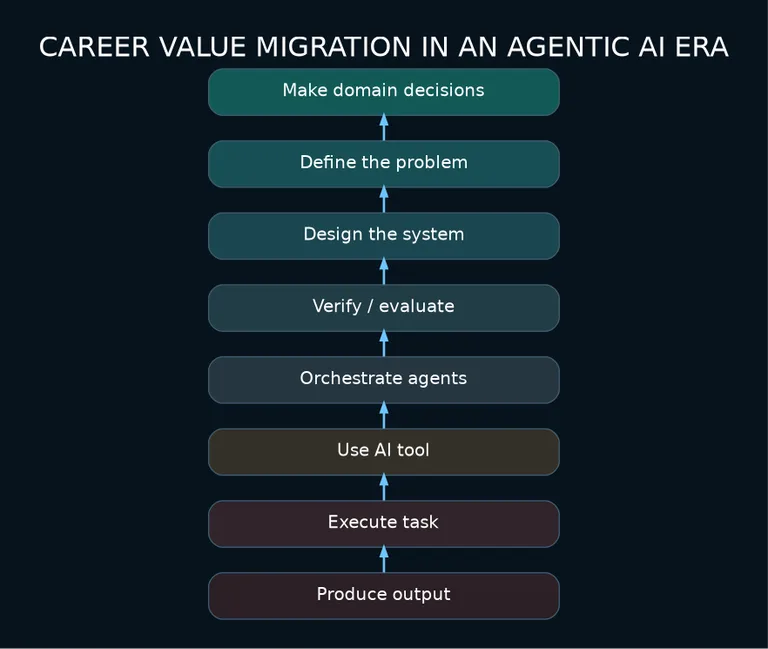
The stronger strategy is to move upward in the value stack:
Produce output
    ↑
Execute task
    ↑
Use AI tool
    ↑
Orchestrate agents
    ↑
Verify / evaluate
    ↑
Design the system
    ↑
Define the problem
    ↑
Make domain decisions
This is not a prediction that entire professions disappear. Jobs are bundles of tasks, responsibilities, relationships, tacit knowledge, accountability and judgment. The more defensible conclusion is that task composition changes. Execution-heavy portions become cheaper; problem formulation, verification, architecture, coordination and accountable decision-making become relatively more valuable.
For developers, that means architecture, test strategy, system boundaries, security, production diagnosis and agent supervision matter more—not less. For researchers, methodology and interpretation matter more as literature search, coding and experiment execution accelerate. For creators, point of view, taste, evidence and narrative judgment become the scarce layer as raw copy generation becomes abundant. For founders, the advantage shifts from prompting skill toward decision design, delegation architecture, evidence quality and operational judgment.
The memorable rule is:
Do not try to become faster than Astra. Learn how to direct Astra—and move your career toward the layers the model cannot safely own by itself.
This is also why model routing matters. The right future workflow is not one human competing with one giant model. It is a human defining goals and boundaries while heterogeneous models perform different roles:
Astra thinks about the system. Sol reasons about the problem. Terra builds the solution. Luna does the chores.
The human remains responsible for objectives, authorization, verification and consequential judgment.
Written by Varun Pratap Bhardwaj, founder of Qualixar and an independent AI Reliability Engineering researcher. Follow @varunPbhardwaj.
This post is about ecosystem →
Varun Pratap Bhardwaj builds AI Reliability Engineering tools at Qualixar. ORCID 0009-0002-8726-4289